Risk Scores are now live on Whop, helping merchants understand and flag payments and buyers carrying payment risk – before they jeopardize sales.
Key takeaways
- Whop Risk Scores rate every transaction and buyer 0-100, exposing fraud signals upfront instead of after disputes.
- Scores combine device biometrics, buyer history, card and network fraud signals, and transaction source into one probability.
- Today the scores guide manual action; soon merchants can set thresholds that block risky payments automatically.
Every transaction carries some amount of risk. We’re here to help you score that risk before it becomes an issue.
Stolen cards, suspicious devices, a buyer with a history of chargebacks. These red flags can turn normal sales into disputes, affecting a merchant's ability to keep processing payments securely.
Sellers usually have to figure this out after the fact. A dispute shows up, a refund gets filed, and only then do they start asking questions about who they sold to.
Now, you get that visibility upfront instead.
Enter: Risk Scores
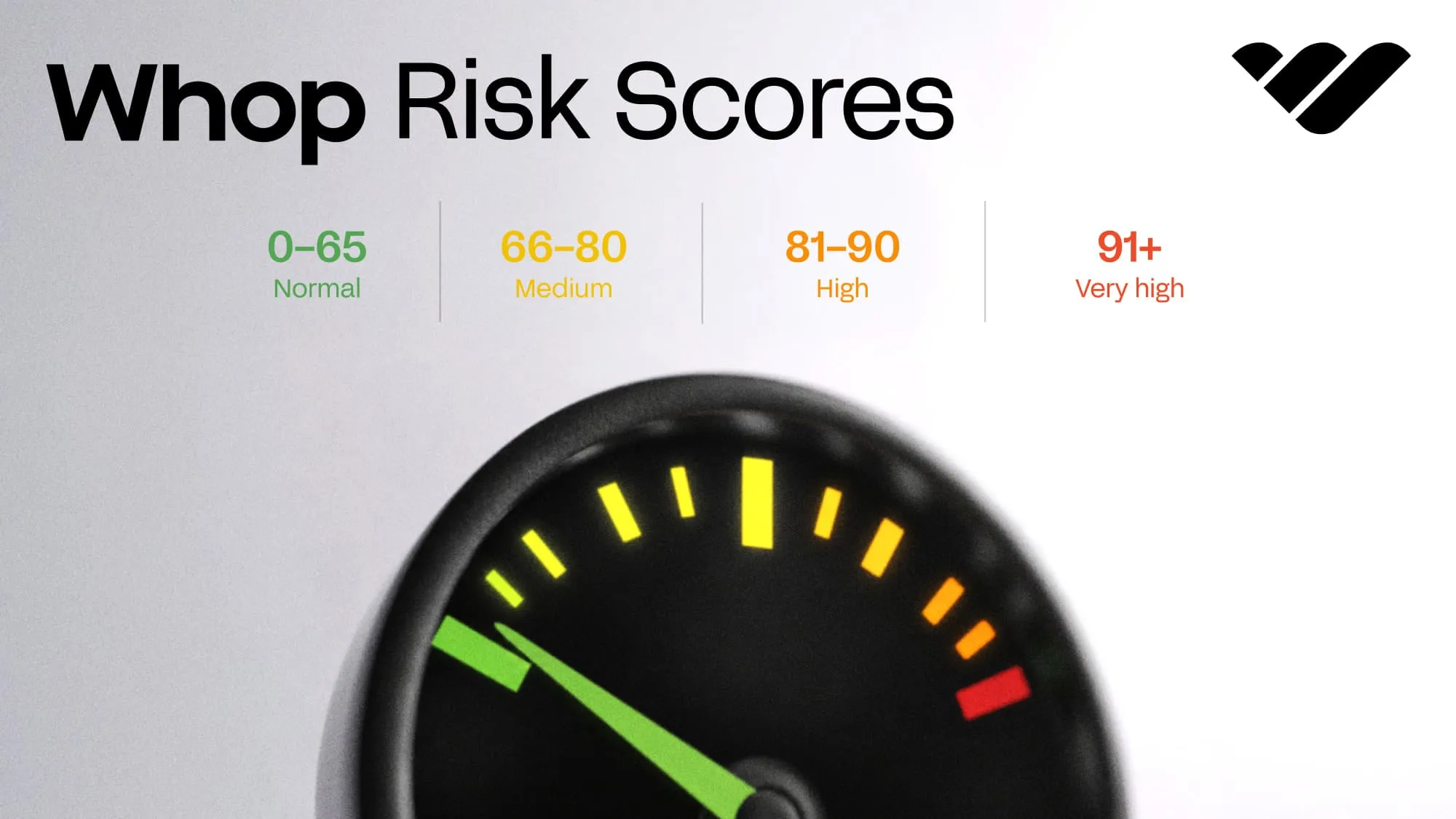
You can now view a risk score from 0 to 100 attached to every transaction and every buyer on Whop.
That also rolls up into an aggregate risk score for the whole business, so you can see your overall health at a glance, as well as at the individual transaction level.
This data allows you to figure out exactly why specific sales can look risky. The goal? Better visibility and a clear picture of who's buying from you.
How the scores are generated
The model pulls from four categories of signals:
- Device metrics: Session-level data and device biometrics at the time of the transaction.
- Buyer history: Everything about that user's relationship with Whop: account age, whether their email is verified, total successful purchases, total transaction amount, prior fraud declines, dispute count, refund count, and transaction volume over the last day, 7 days, and 30 days.
- Network and card details: Card-level fraud signals, including how many times that card has been flagged for fraud and how many transactions it's been tied to, broken out across rolling windows (5 minutes, 30 minutes, a day, 7 days, 30 days, a year). You’ll also be able to see the historical decline rate reported by payment processors.
- Transaction source: This tells you whether the charge came in through the API, an on-session checkout (buyer actively present), an off-session charge (using a saved card with no buyer present), or a subscription renewal. Each source carries a different baseline level of trust.
The tech running underneath
Under the hood, Risk Scores run on an XGBoost decision tree which takes in all of the signals above, and produces a raw score.
That score is then passed through logistic regression, which converts it into a clean probability, i.e., the 0-100 number you’ll actually see within your Payment ID breakdowns, accessible from your business dashboard.
“Essentially it's a decision tree that takes in these features and outputs a score between zero and one hundred. And then on top of that we do logistic regression in order to create the probability score.”
– Ritvik Gudlavalleti, Whop payments engineer
Risk Scores show up right on the payment detail page.
Every transaction gets a review widget with a plain-language risk label (low, medium, or high), alongside a few key signals at a glance: whether the name and email match, the auth rate, source location, and IP address.
Want more info? Click "See details", and the widget expands into a full score breakdown, split into two groups:
- Fraud history: Has this IP address triggered early fraud warnings before? Has it been tied to previous disputes?
- Customer details: Account age, number of past successful purchases, past disputes, and recent declines in the last hour.
With this information, you can identify with clarity whether specific payments look legit (or not).
What’s next?
As of now, Risk Scores are a visibility tool.
You’ll get individual scores for buyers and payments, and you can then take action based on those scores: refunding a payment, banning a user, or just watching more closely.
But soon? You’ll get real-time enforcement. Merchants will be able to set their own risk threshold. That means transactions, IPs, or users that cross those thresholds get blocked automatically, before the sale ever goes through.
We’ll keep you updated as these changes roll out.
Get ahead of payment risk with Whop
Alongside other features like 3DS, Risk Scores have been designed to help our sellers stay ahead of risk before it has an impact on their sales and business.
If you're selling on Whop, you'll be able to view the risk rating for all purchases and buyers within your dashboard, with more capabilities to come in the near future.
It's part of our pact to help you earn a sustainable income online.