Thinking of starting a business? Read this guide to understand how much it really costs to start a business, from online ventures to physical storefronts.
Key takeaways
- Digital products like ebooks, courses, and SaaS offer the lowest startup costs and risk for new entrepreneurs.
- Dropshipping and reselling let you sell physical products without large inventory investments upfront.
- Understanding your specific industry's cost structure helps you plan realistically and avoid common financial pitfalls.
Starting a business is exciting, but you may be focused on goals and timelines, while forgetting the most important question: how much will it actually cost to get started?
Too many entrepreneurs have amazing ideas, but fail simply because they weren’t ready for the money side of things.
I mean, even the best idea won’t go far if you don’t plan for startup costs, tools, marketing, and other expenses.
Knowing this ahead of time can save a ton of stress and set you up for real success.
In this guide, we’re going to break down different industries and show what it really costs to launch a business in each one.
We’ll give real examples, so you can see how other people did it, how much they spent, and what worked.
Let’s take a look.
5 types of business costs to be aware of
There’s no single number that tells you exactly how much it costs to start a business — it really depends on what kind of business you want to create and the industry you’re in.
Even though costs vary, most businesses share some common expenses.
Here’s a list of the typical startup costs you’ll see across different types of businesses:
1. Production costs
Production costs are one of the first things you need to think about when starting a business.
For digital products, the good news is you can often make them for free using online tools, templates, or platforms. You might create ebooks, online courses, printables, or even software without spending a dime upfront.
This makes digital products a low-risk way to test an idea and start earning.
Costs are higher for physical products because you need inventory.
You can start small by reselling products, which allows you to buy only what you need and keep your initial budget low.
If you want to manufacture your own product, you’ll need money for prototyping, samples, patents, and minimum order quantities — this can quickly add up to thousands of dollars.
Dropshipping is another option where you can sell products without buying inventory first, making it a low-risk alternative.
Whichever route you choose, understanding your production costs is key to setting realistic pricing, creating a profitable business model, and planning for growth.
2. Storefront costs
Every business needs a storefront, whether it’s digital or physical. For digital products, you can use an ecommerce platform to act as your online shop.
Some platforms are free, while others cost a few hundred dollars per month. Don’t forget additional costs like domain hosting, servers, or custom development if you want a more unique experience for your customers.
It's free to build a whop hub and list products - we only make money when you do.
If you’re selling physical products, you have two options: open a brick-and-mortar store, which comes with rent, insurance, and staff costs, or you can create an online store.
Ecommerce stores are generally cheaper, reach a wider audience, and are easier to scale — which is why most new entrepreneurs start online.
Choosing the right storefront option is all about balancing cost, reach, and convenience.
Having a storefront is essential to getting your product to your customers, so this is one of the most important costs to consider.
3. Fulfillment costs
Once your product is ready, it needs to get to your customers — this is fulfillment.
Fulfilling digital products is usually simple, with platforms handling downloads automatically.
For physical products, you’ll need to cover shipping, packing, storage, and returns. Even if a third party helps, the costs are still yours.
Planning keeps things smooth and makes customers happy — fast, reliable delivery can turn first-time buyers into repeat fans.
4. Staff costs
Even if you start a business alone, you’ll likely need help as it grows.
Staff can include freelancers, contractors, or full-time employees. Hiring allows you to focus on tasks that bring the most value, while others handle routine or time-consuming work.
Only hire when necessary and ensure the cost is worth the return.
Research fair market rates for the work you need done, and consider starting with part-time or contract workers to minimize risk.
Staff costs can add up, but they’re often a key factor in scaling a business successfully.
5. Product marketing costs
Even if your product is goated, it won’t sell if no one knows about it.
A good rule of thumb is to allocate up to 10% of revenue to marketing, though scaling quickly may require a higher percentage.
The type of marketing you'll use depends on your product: digital and service businesses often focus on lead generation, social media campaigns, influencer marketing, or paid ads.
Physical product businesses might also use in-person strategies like trade shows, demos, or events.
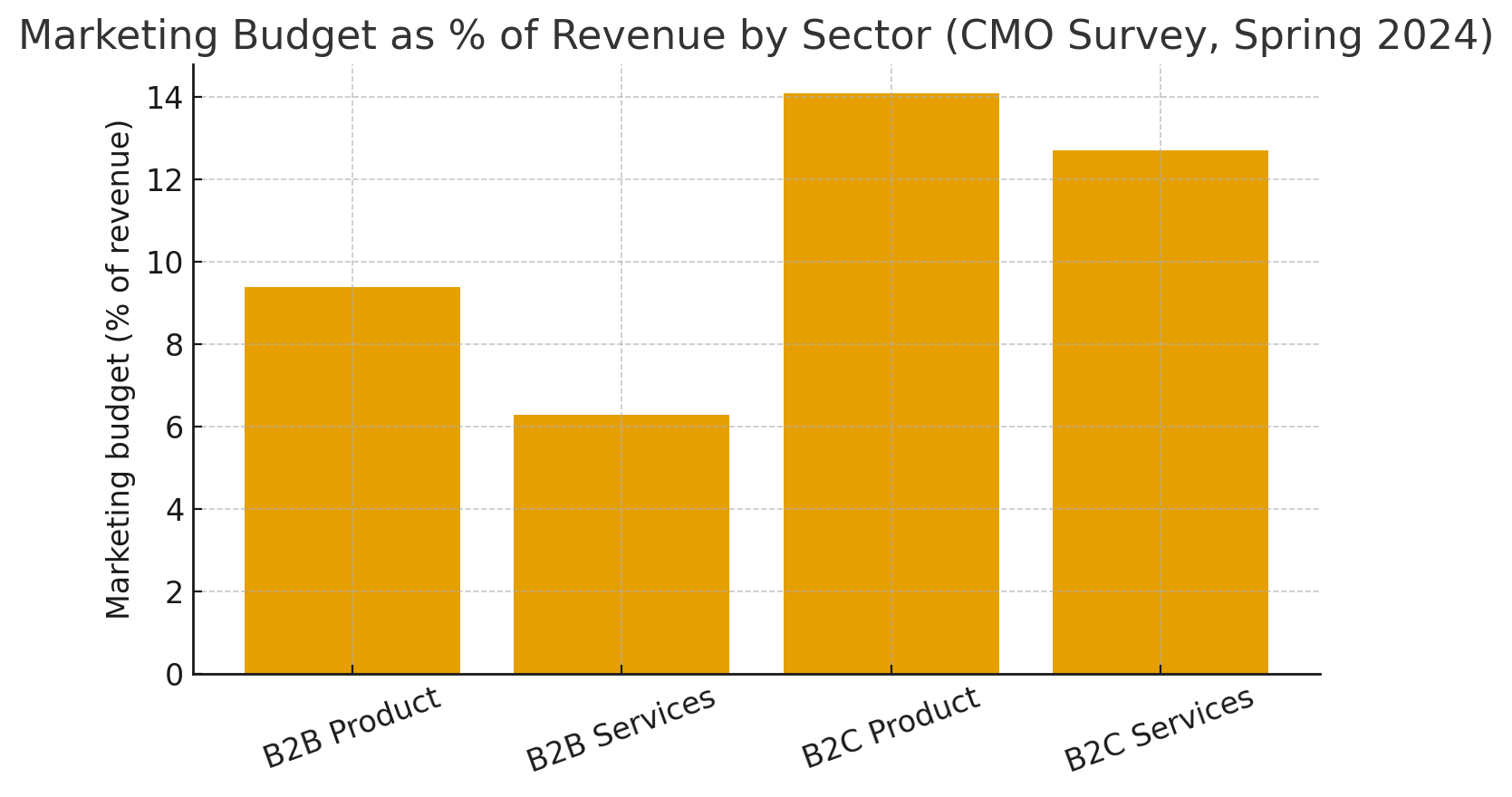
The CMO Survey (Spring 2024) shows that average marketing spend differs by sector: B2B Product: 9.4%, B2B Services: 6.3%, B2C Product: 14.1%, B2C Services: 12.7%.
How much does it cost to start a small business?
So, how much does it actually cost to start a business? It depends.
Some businesses barely cost anything to get going, while others can set you back a small fortune.
If you’re thinking online stores or digital products, you’re in luck — you can often get started with just a laptop and some free tools.
Physical businesses usually cost more upfront and take more money to keep running.
Here’s a quick look at what starting different types of businesses might cost so you know what to expect:
| Industry | Average startup costs | Key expenses |
|---|---|---|
| Digital product ecommerce | $200-$500 | Online platform fees, domain and server hosting, email marketing, product development |
| Physical product ecommerce | $500-$10,000 | Product sourcing or development, online platform and fulfillment fees, storage |
| Online reselling | $50-2,500 | Product sourcing, online platform fees |
| Online services/agency | $1,500-$5,000 | Website development, marketing and advertising, training and certifications, staff |
| Media (Instagram, TikTok, YouTube, Podcasting) | $500-$5,000 | Audio and visual equiment, recording and editing software, website, marketing |
| Physical reselling store | $15,000-$50,000+ | Lease, inventory, insurance, licensing and permits, POS system, store preperation, staff |
| Restaurant | $75,000-$200,000+ | Lease, kitchen equipment, POS system, licesnses and permits, inventory, staff, marketing, Insurance |
| Cleaning business |
$5,000-$10,000 |
Cleaning supplies and equipment, insurance, marketing and advertising, website, vehicle (if necessary) |
| Storage unit business | $1,000,000+ | Sufficient land purchase or lease, construction or renovation, security systems, management software, insurance, staff, marketing and advertising |
| Tech startup | $50,000-$200,000+ | Software development, hosting and server costs, legal fees, user acquisition, staff |
5 small businesses you can start on a budget:
We’ve already seen that starting a small business can get expensive fast — there are lots of costs to think about. But even with a small budget, there are plenty of ways to get started.
Some businesses barely cost anything to launch, and you can grow them over time without any upfront investment. The key is picking a business that matches your budget and skills.
Here are a few of the best types of businesses you can start without breaking the bank:
1. Digital products
If you’re starting a business with a small budget, digital products are your best friend. They’re cheap to make, easy to sell, and there’s so much variety you can choose from:
- eBooks: Use free tools like Google Docs or Canva to write and design your ebook. Once it’s ready, export it as a PDF and sell it on a platform or marketplace. With some creativity and a little marketing on social media, you could start an ebook business for almost nothing.
- Online courses: Creating an online course is similar to selling an ebook, but it takes more time and equipment. You’ll need video and audio tools to make high-quality content, and a platform to host your course.
With Whop, you can host courses for free and even attach extra documents for your students, creating a cohesive learning experience (and more income).
- Online communities: Communities help you keep customers engaged, grow loyalty, and create another revenue stream. While platforms like Facebook, Discord, or Telegram work, Whop lets you set up your own community quickly, with forums, channels, and apps to add even more value for your members.
- SaaS (Software as a Service): If you’re tech-savvy, creating SaaS is an epic option. Simple tools like schedulers, organizers, or Chrome/ChatGPT plugins can be packaged and sold to lots of users. Your main costs? Hosting and marketing, since you’re building the product yourself.
These are just a few examples of digital products that can launch a business with minimal money. With some creativity and effort, the possibilities are profitable AF.
More on selling digital products:
2. Online services
If you’ve got a skill, you don’t need a product to start a business — you can sell your time and expertise online.
Think coaching, tutoring, or consulting. It’s a great way to turn knowledge into money without worrying about inventory or shipping.
The key is to pick a skill you know really well and make it super obvious to customers what they’ll get when they work with you. The more specific you are about deliverables, the easier it is to sell.
There are lots of platforms that help people offer online services. Some let you tutor languages or school subjects, while others are for professionals offering coaching or consulting.
Usually, you’ll pay a small transaction fee or membership fee, and the platform helps connect you with customers — saving you a ton of time and effort on marketing.
Bundle services on Whop under one storefront: coaching, courses, tutoring, 1:1 support.
Learn more about selling services:
3. Reselling
Starting a reselling business is one of the easiest ways to launch with any budget.
Some people get started by buying something for just a dollar at a thrift store and flipping it for $20 or more online, simple as that.
You don’t need a ton of expertise, either. All you need is an eye for profitable items and a little patience.
The great thing? Reselling works in almost every niche, so you can focus on items you actually enjoy — which makes growing your business way more fun.
You can reinvest your earnings into more inventory or learning new skills to reach bigger goals and make your side hustle into a full-fledged business.
More on reselling:
4. Dropshipping
Dropshipping is one of the easiest ways to start a physical product business on a tight budget.
Instead of buying and storing products yourself, a third-party supplier handles most of the work — so you don’t have to pay for inventory upfront.
Getting started is simple: find a dropshipping supplier, set up your store, and start selling.
The trade-off? Because it’s so easy to enter, dropshipping is super competitive, and profit margins can be slim.
More on dropshipping:
5. Podcasts

Podcasting is a low-cost way to start a business. You’ll need some basic audio equipment, a quiet space, and maybe editing software — that’s it.
Uploading and hosting your episodes is usually free, with small fees only if you want bigger storage or advanced analytics.
You don’t have to be an expert to start. Today, anyone with curiosity and a unique perspective can find an audience.
You could start a podcast documenting your early experiments with making money using AI — sharing what works, what fails, and updates on the latest trends.
Podcasting also opens up lots of ways to monetize once your audience grows – communities, live events, exclusive content, merch – you get the idea.
More on podcasting:
Launch your business with Whop
Business costs don’t have to be sky-high.
Whether you choose to create digital products, offer online services, resell items, or start dropshipping, there are low-cost options that let you get started today.
The key is to pick a business that matches your skills, interests, and budget, start small, and reinvest your earnings to scale over time – even a small offer can grow into something profitable and sustainable with the right platform and consistent effort.
Whop makes it easy to sell and manage your products with minimal upfront costs, simple payment processing, low fees, and tools to grow your audience.
Ready to turn your idea into a real business? Sign up with Whop today and start selling your first digital product in minutes.
Business starting costs FAQs
What’s the average cost to start a business?
The average cost to start a business varies widely depending on the industry, the type of product, and the business model. In general, digital products such as ebooks, courses, and communities have the lowest average starting cost that is can be in the range of a few hundred dollars. On the higher end of the spectrum will be tech startups, restaurants, storage businesses and extensive online services such as high level B2B agencies where initial costs can easily be in the five, six or even seven figures.
How much cash runway should I set aside before I launch?
Cash runway is how long you can operate before you run out of money. A simple way to plan it:
- Estimate monthly operating expenses (OPEX): rent/hosting, software, payroll/contractors, marketing, insurance, etc.
- Estimate monthly gross profit: revenue × gross margin.
- Monthly net burn = OPEX − gross profit (if this is negative, you’re profitable).
- Runway (months) = Starting cash ÷ Monthly net burn.
Example: If you expect $15,000 monthly revenue at a 60% margin (=$9,000 gross profit) and $12,000 OPEX, your net burn is $3,000. With $30,000 in the bank, your runway is 10 months.
How much runway you should have depends on your model and how quickly cash comes back to you. Digital products and early SaaS can often launch with 3–6 months if sales cycles are short; service businesses may be fine with 2–3 months plus a buffer for late invoices; inventory-based ecommerce typically benefits from 4–6 months plus at least one full inventory cycle; and brick-and-mortar or food concepts are safer with 6–12 months given buildout and slower ramp times. Whatever your model, add a 15–20% contingency for surprises, keep a separate tax reserve, and watch payback: if customer acquisition costs take longer than a year to recover—or inventory turns slowly—tighten spending or use short-term working capital instead of long-term debt.
Should I ask for money to start my business?
In general, it’s best practice to self-fund or bootstrap your business when starting out. Asking for money to start a business will give you an added burden and the responsibility to repay your loan, which can either mean a high interest rate, a large chunk of equity given away, or both. You should only seek external funding if you have a proven business model with some history and your operational costs are forecasted to significantly exceed your personal resources. Another time when asking for money is appropriate is if your business model or profit margins require rapid scaling in order to compete or remain viable.
Should I start a business with a loan or a credit card?
While some people start businesses with a loan or a credit card, it’s generally not recommended to have the added risk of financial obligation when taking the already uncertain path of starting a business. However, when it comes to scaling your business, prudent use of credit cards and low-interest loans can be essential tools to help maintain healthy cashflow and give you the opportunity to scale.
How can I calculate the initial costs for my business?
When it comes to putting together a budget for your intended business as a new entrepreneur, it’s important to be reasonable but realistic. In order to accurately calculate the initial costs of your business, begin by listing out all necessary expenses, which can potentially include inventory, staff, marketing, and a method to fulfill your product. You should also add in an extra buffer for unexpected expenses in addition to paying special attention to any ongoing fees that are associated with operating your business.
What are the best businesses to start with a low budget?
The best low-budget businesses are those that leverage your existing abilities and free or cheap to use online platforms and have little to no cost for production or sourcing of inventory. Digital products, dropshipping, simple online services and reselling fulfill these traits and are generally the cheapest to get started with, having a required initial budget that can be under a few hundred dollars.