Whop, Stripe Identity, Veriff, Sumsub, and Persona are some of the best KYC APIs in 2026. Read our article to learn more about each and find the right one for you.
Some of the best KYC API providers you can work with in 2026 are Whop, Stripe Identity, Persona, Sumsub, and Veriff. Each one has a different mix of use cases, pros, cons, and integration steps.
A KYC (know your customer) API is how you verify a person is who they say they are. This is usually done with a picture of an ID and a live selfie to match it. Many providers also check the person's details against sanctions lists.
A platform needs KYC when a regulator, a bank partner, or a payout provider requires it to know who it's moving money for.
But with so many options, choosing one isn't that simple. With different requirements for each KYC API provider, we are going to take a look at the best of them in 2026, what each one is good at, and how to pick the right one for your platform.
How we chose and evaluated these KYC APIs
Our list includes the KYC providers developers use most, plus providers that come with payment rails.
We compare each by how hard they are to integrate, how the verification flow fits into your platform, what they check, and how much you'll pay.
KYC APIs compared
| Provider | Best for | Price | Free sandbox without sales |
|---|---|---|---|
| Whop | Platforms that pay their users | Free | Yes |
| Stripe Identity | Teams already on Stripe | $1.50 per check, first 50 free | Yes |
| Persona | Different flows for different users | From $250 a month | Yes |
| Sumsub | KYC and AML from one provider | From $1.35 per check | Yes, card needed |
| Veriff | Cheap, fast ID checks | From $0.80 per check | Yes |
| Didit | Lowest price | $0.33 per check | Yes |
| Plaid IDV | Apps already on Plaid | Not public | Yes, US, Canada, UK companies |
| Socure | US fraud prevention | From $0.80 per check | Yes |
| Jumio | KYC at enterprise scale | Quote only | No |
| Entrust IDV | Existing Entrust customers | Quote only | No |
| Trulioo | Verifying businesses globally | Quote only | No |
11 best KYC API providers
Whop
Best for: platforms and marketplaces that want to pay out to their users
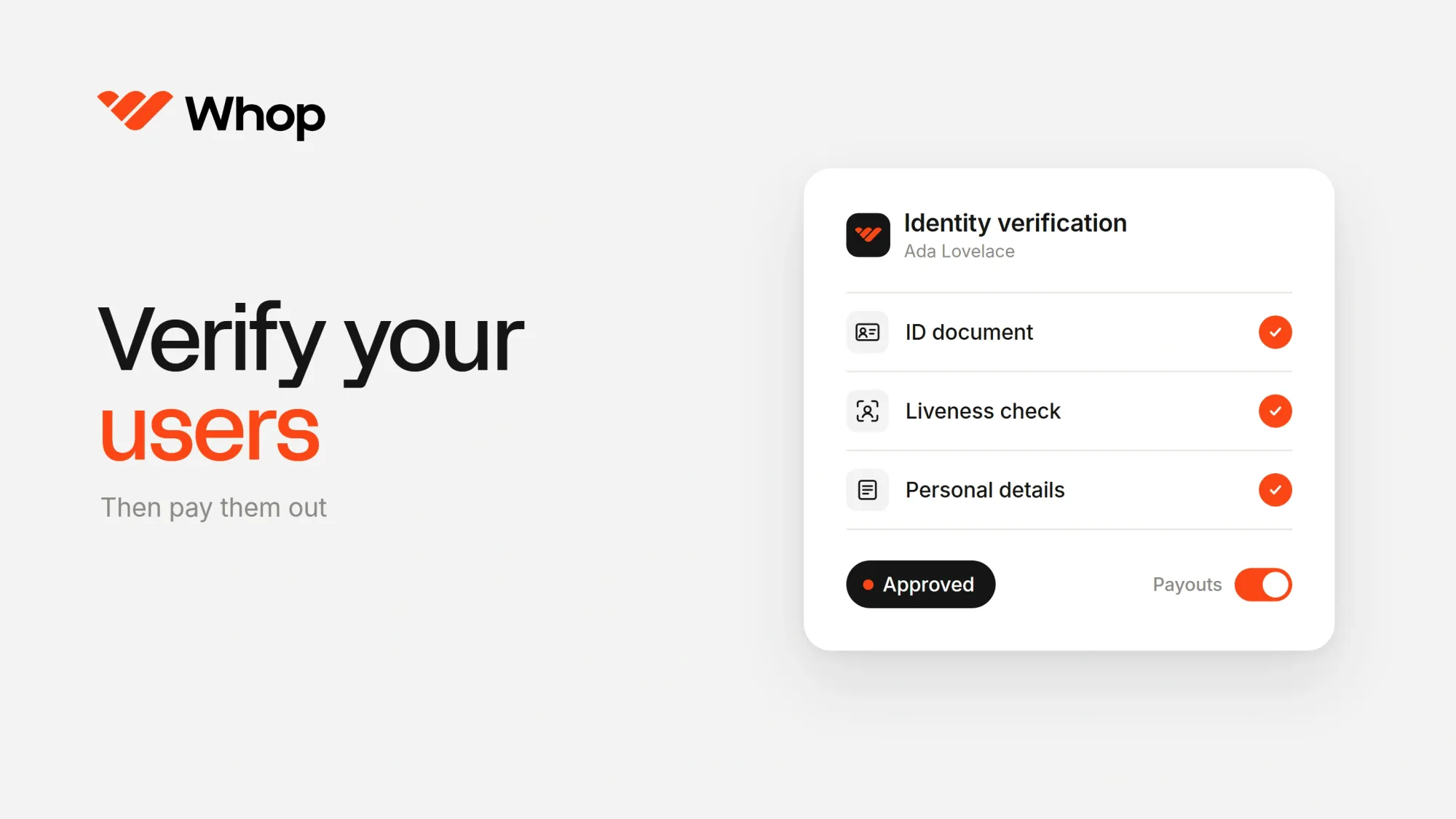
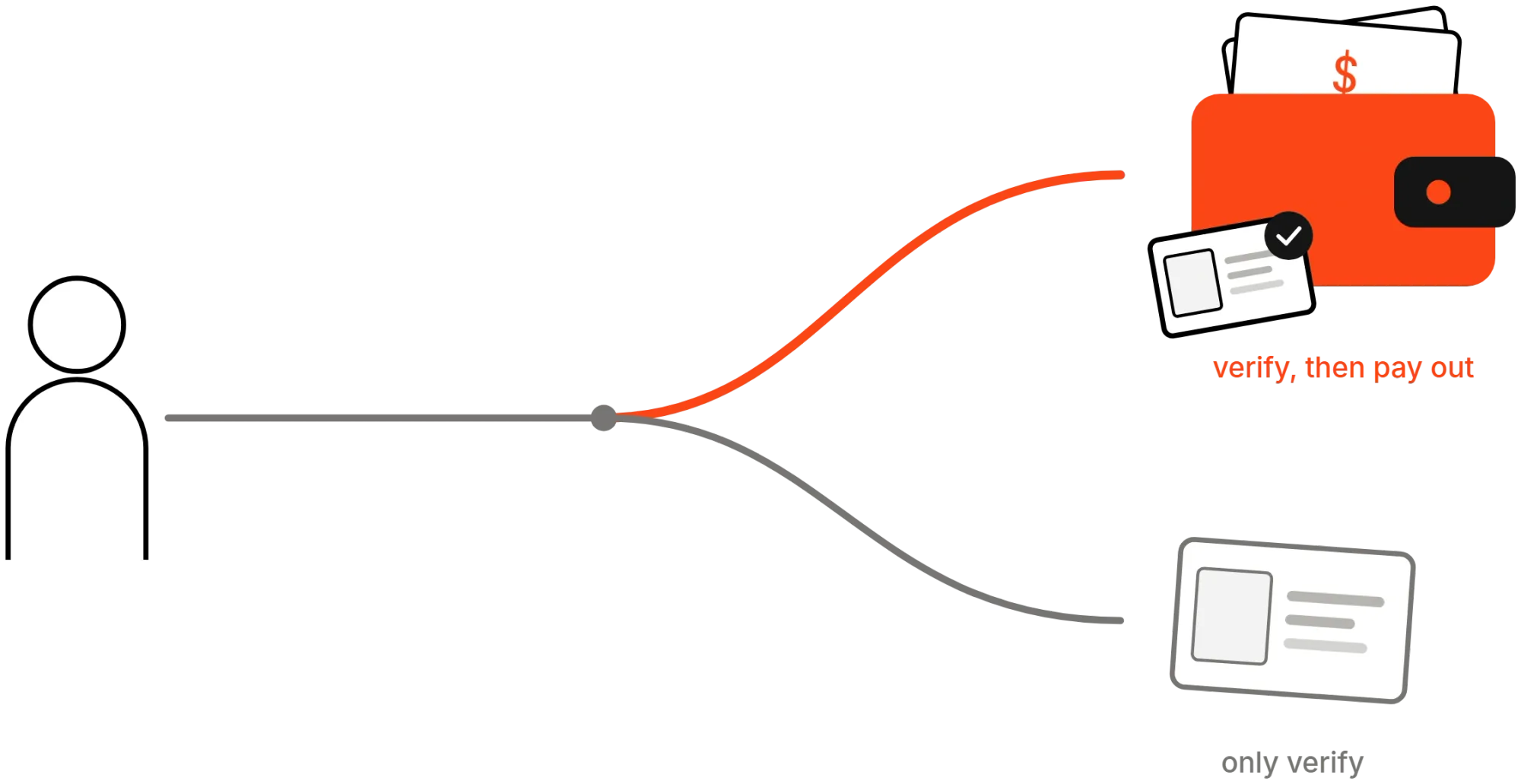
Most platforms verify people because they're going to send money to them. This is done because payout providers need to know who they’re sending money to. When you use a separate KYC provider, you're going to have to integrate two new flows into your platform and make sure they work together without any problems.
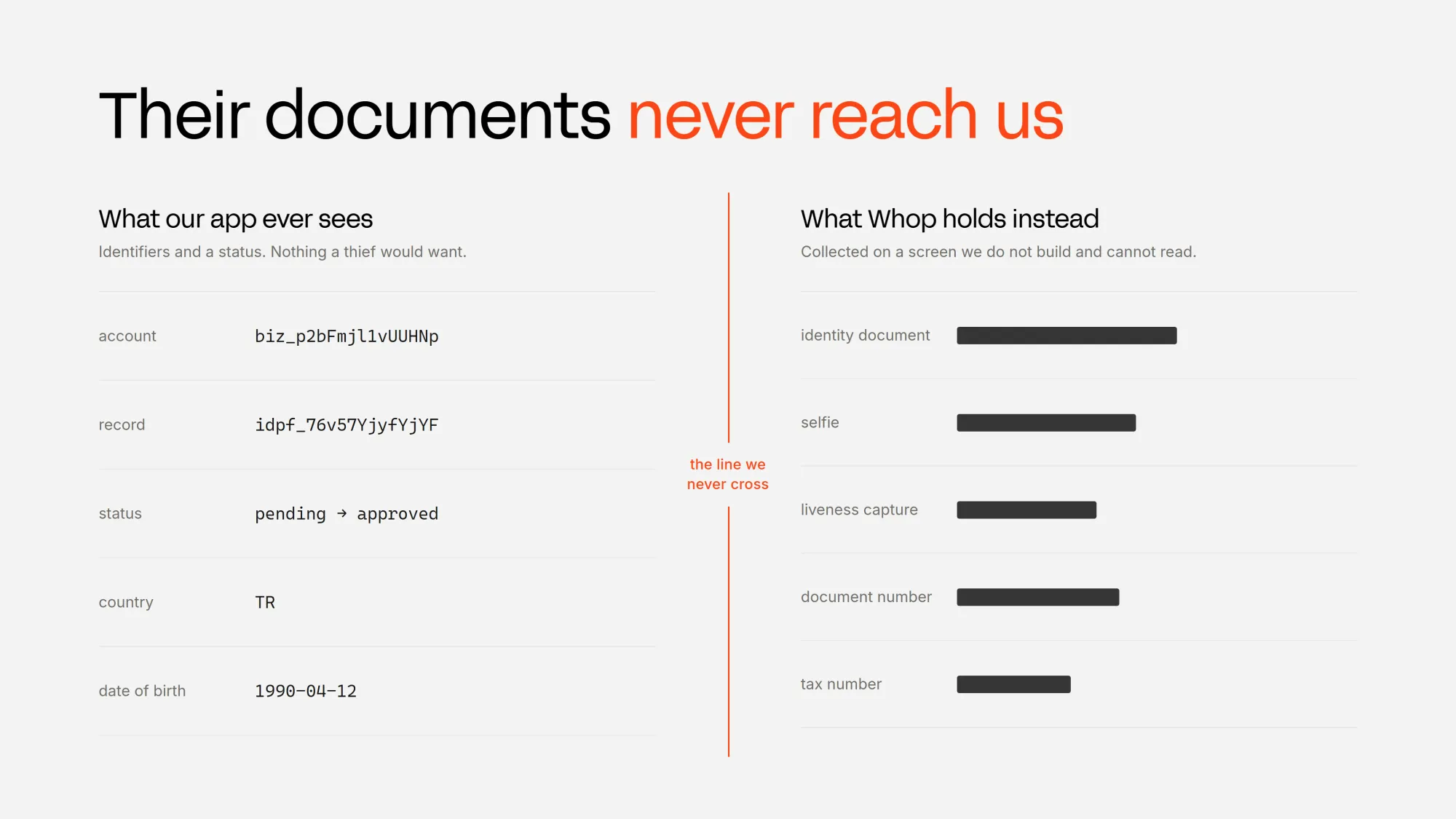
Whop, on the other hand, puts that verification inside the same API that creates accounts for your users, takes payments for them, and pays them out. You create a verification for a connected account, Whop runs the checks, and once it's approved, that account can receive payouts.
Platforms like FoodFluence and SideShift already pay their users this way, through Whop's embedded payout portal.
Whop's verification features:
- Hosted verification page
- Embedded KYC element
- Individuals and businesses
- Additional information requests
- Reusable verification
- Payments and payouts to the same account
While we were preparing our KYC integration tutorial, a test user completed the KYC flow (ID, a liveness check with the camera, and then personal details) in a few minutes using test documents.
Under the hood:
- SDKs: Official libraries for TypeScript, Python, Ruby, Go, and Rust, plus React components for embeds
- Webhooks: Signed webhooks tell your server when a verification changes, and your server then reads its new status
- Sandbox: Test the hosted KYC flow end to end on Whop Sandbox without affecting production. The embedded element isn't available on sandbox yet
- Pricing: Free. Identity verification is built in for every user at no extra cost
If you are looking to pay out to your users, Whop is the best choice because verification, account creation, and payments share the same integration.
Stripe Identity
Best for: platforms that already work with Stripe
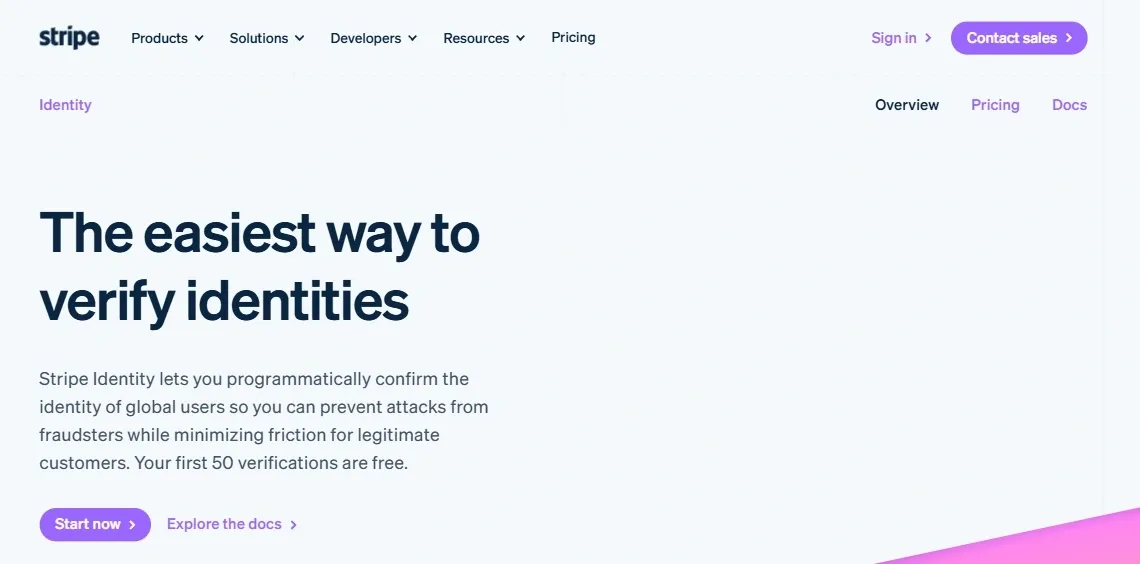
If your platform already runs with Stripe, integrating the Stripe Identity KYC API will be easy for you. You can enable it in the Stripe dashboard and create verifications through the APIs and libraries you already use. Each check matches a photo ID to a selfie.
Stripe Identity features:
- Hosted page or modal
- Native mobile SDKs
- ID number lookup (paid)
- Codeless option
Under the hood:
- Webhooks: Stripe lets you know when a verification is complete or the user has to try again
- Sandbox: With the sandbox test mode, it acts like the production mode but the real checks don't run
- Pricing: With the first 50 verifications being free, you pay $1.50 per verification and $0.50 for SSN lookups
- Billing: No matter if the user has passed the verification or failed it, the check will be billed. Abandoned verifications are free, but failed verifications are not
- Usage: Stripe Identity is generally available to businesses in the US, UK, and Japan, and about 30 more countries are in public beta
Stripe Identity is a good option for people who want simple ID and selfie matching and for teams that already use Stripe. Keep in mind that it only verifies individuals and doesn't check users against sanctions lists, so platforms that move money will need a second provider for AML.
If you pay out through Stripe Connect, Stripe already runs KYC on your connected accounts, so Stripe Identity is mostly for checks that don't involve payouts, like age checks or opening an account.
Persona
Best for: platforms that want to provide different verification flows to different users
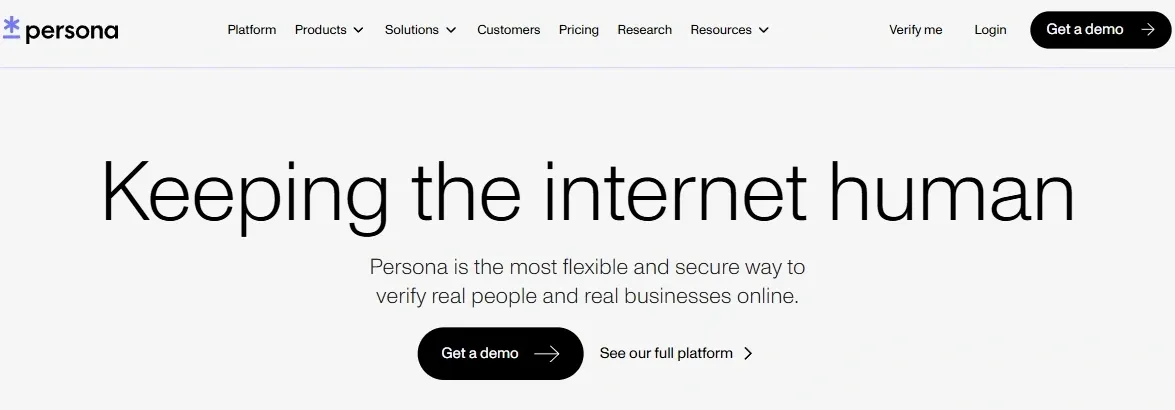
Persona is built for customizability. You design the verification flow on its dashboard and bring the ID, selfie, database, phone number, email, and document checks together into one. Then without changing any code, you can run different flows for different users or risk levels.
Persona features:
- Flow builder
- Many verification types
- Business verification (Growth plan and up)
- Screening reports
Under the hood:
- Integration: Hosted and embedded flows, a JavaScript SDK, and iOS, Android, and React Native SDKs
- Webhooks: When verifications are complete, Persona sends your server webhook payloads, including the watchlist and PEP scans
- Pricing: The Essential tier starts at $250 a month with a 12-month agreement, including 500 verifications, with each additional verification costing $1.50. Growth and Enterprise pricing is quote only
- Sandbox: 60-day trial with 50 verifications without needing a credit card
- G2 rating: 4.2 out of 5 (48 reviews)
Persona is a good option for platforms that have multiple types of customers and want to provide different KYCs to each one. Its downsides are the slower path to production and the year-long commitment in the entry tier.
Sumsub
Best for: platforms that want KYC and AML scans across the world from a single provider
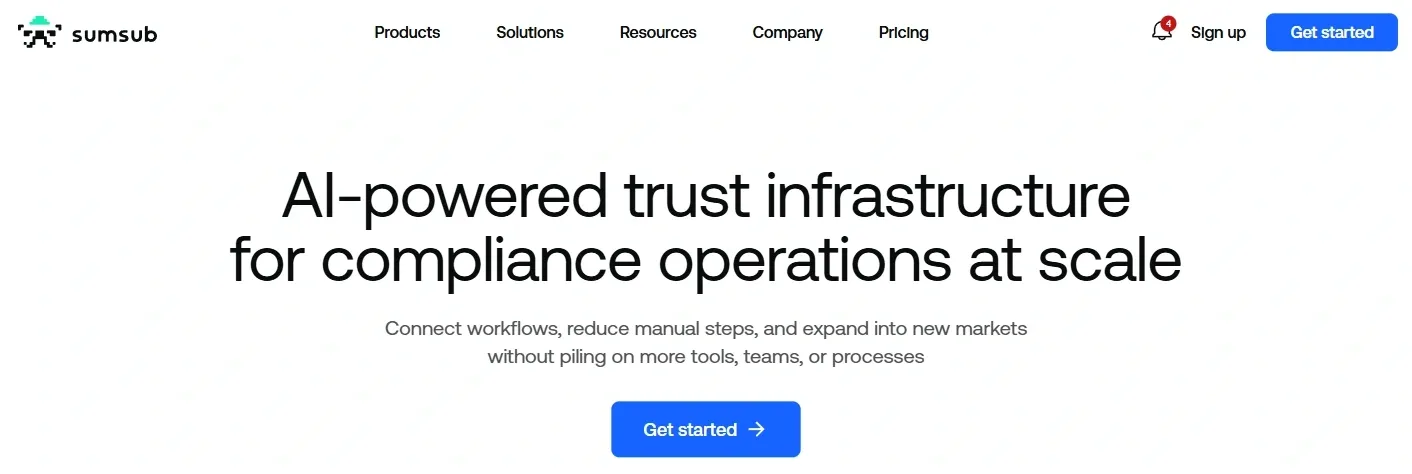
Sumsub works in over 220 countries and territories with ID verification, liveness checks, and face matching. The Compliance tier of Sumsub also includes AML scans, so that you don't need additional integrations to search for your users in sanctions lists.
Features of Sumsub:
- ID and liveness checks
- Business verification (Custom plan)
- AML screening (Compliance plan)
- Reusable verification across platforms that use Sumsub
Under the hood:
- Integration: Links for hosted KYC, a WebSDK, React components, iOS, Android, React Native, and Flutter SDKs
- Sandbox: The trial includes 50 checks across 14 days, needs a credit card, and switches to a paid plan automatically when it ends
- Result notifications: Sumsub lets your app know when a verification is done and reviewed
- Pricing: The Basic tier of Sumsub is $1.35 per verification (with a $149 monthly minimum), Compliance tier is $1.85 ($299 monthly minimum), and Custom by quote
- G2 rating: 4.6 out of 5 (125 reviews)
Sumsub is a good choice for platforms that need KYC and sanctions screening together with public prices. Users who already verified with Sumsub on another platform can also reuse that verification, which makes their KYC faster.
Veriff
Best for: apps that need cheap and fast document and selfie checks
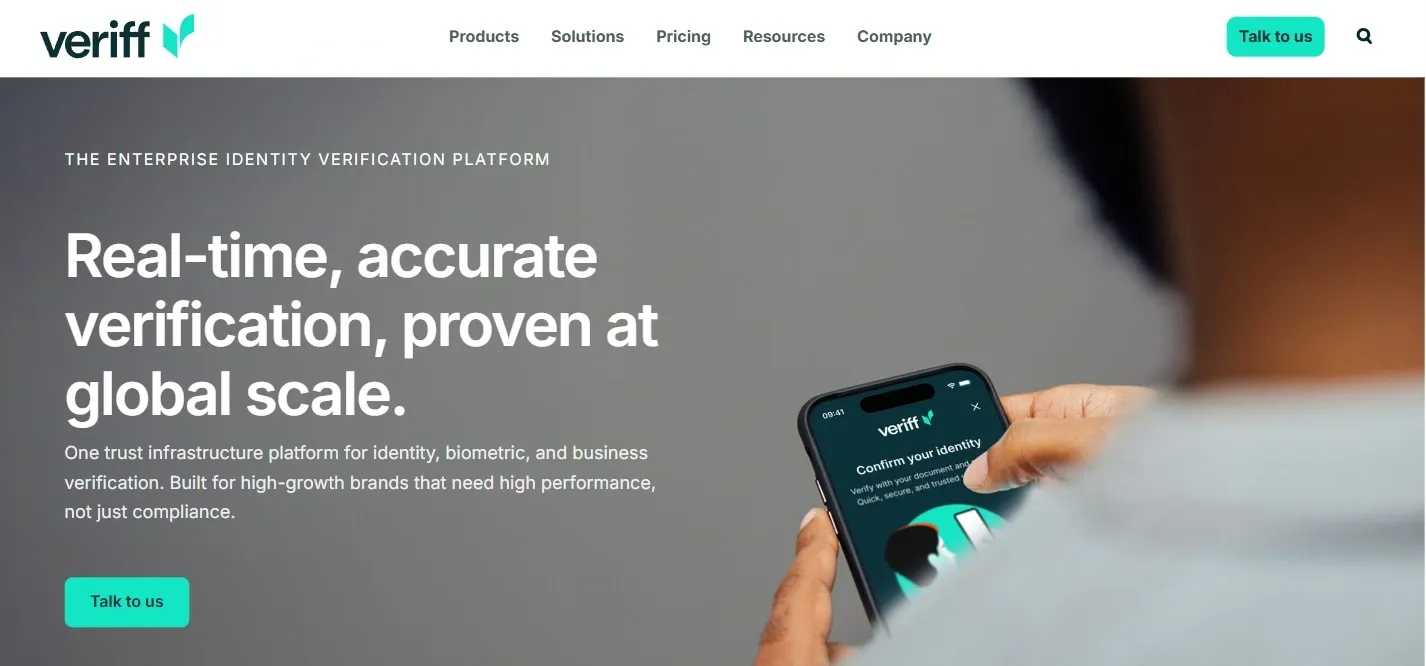
Veriff is a KYC API provider with fast ID and selfie checks. With documents from over 230 countries and a flow in 50 languages, Veriff offers hosted redirects, two web SDKs, and cheaper verifications than most of its competitors. While Veriff stands out with its speed, some user reviews report false declines.
Veriff features:
- Large SDK support
- Free retries
- AML add-on
- Business verification (through sales)
Under the hood:
- Status notifications: Veriff sends every decision to your server, and you can also get every step a user takes in the flow
- Sandbox: All accounts can try out the flow with a free and unlimited test integration
- Free trial and limits: The free trial gives you 15 days or 50 live verifications on the Premium plan without needing a credit card. Self-serve plans are limited to 10,000 verifications per month
- Pricing: The Essential tier charges 80 cents per verification with a monthly minimum of $49. The Plus tier charges $1.39 with a minimum of $99 and Premium charges $1.89 with a minimum of $209
- G2 rating: 4.5 out of 5 (60 reviews)
Veriff stands out with its cheaper verification charges and multi-SDK flow.
Didit
Best for: the lowest price per verification
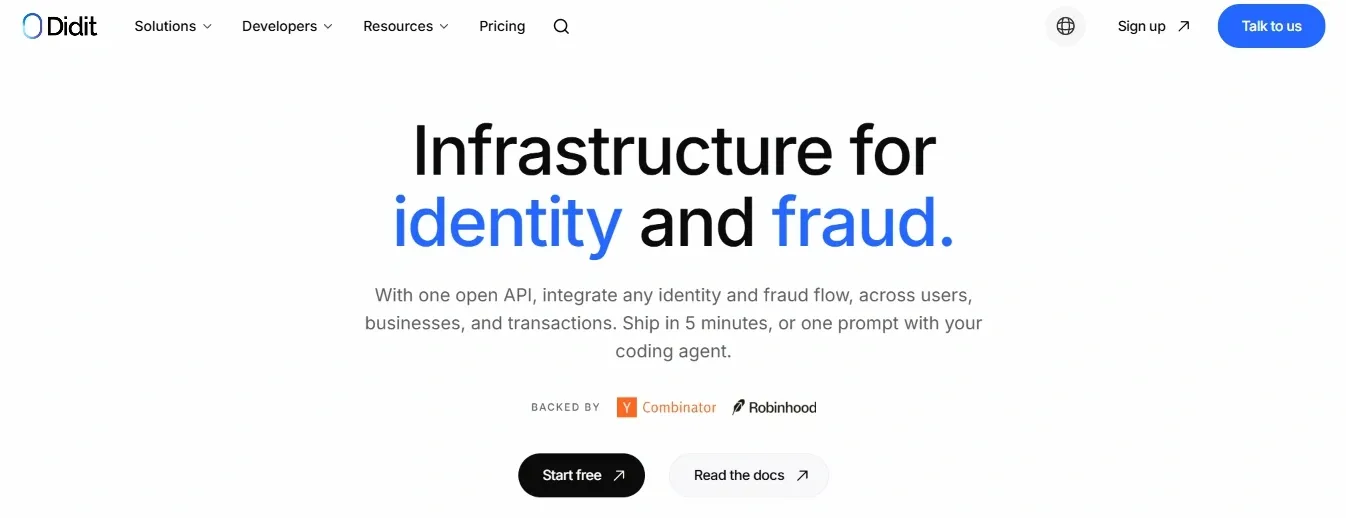
Didit is the cheapest option on our list. It provides a full KYC check with ID, liveness, face matching, device and IP signals for only $0.33. It lets users go through its hosted KYC page, and provides a JavaScript SDK and iOS, Android, React Native, and Flutter SDKs for your app.
Didit features:
- Lower prices per verification
- Free monthly allowance
- Large SDK support
- Business verification (some parts still rolling out)
Under the hood:
- Result notifications: When the status of a verification changes, Didit lets you know
- Pricing: $0.33 per full KYC check and $0.20 per AML screening, with no monthly minimum. The free plan covers 500 checks a month until October 31, 2026, and then switches to $10 of credit a month (about 30 checks)
- Billing: Every completed verification is billed, even if it's declined
- Sandbox: Didit's sandbox is free, unlimited, and doesn't need a credit card
- G2 rating: 4.8 out of 5 (33 reviews)
If you have a limited budget, Didit is the best option for you as a KYC provider.
Plaid Identity Verification
Best for: US, Canada, or UK apps that already use Plaid
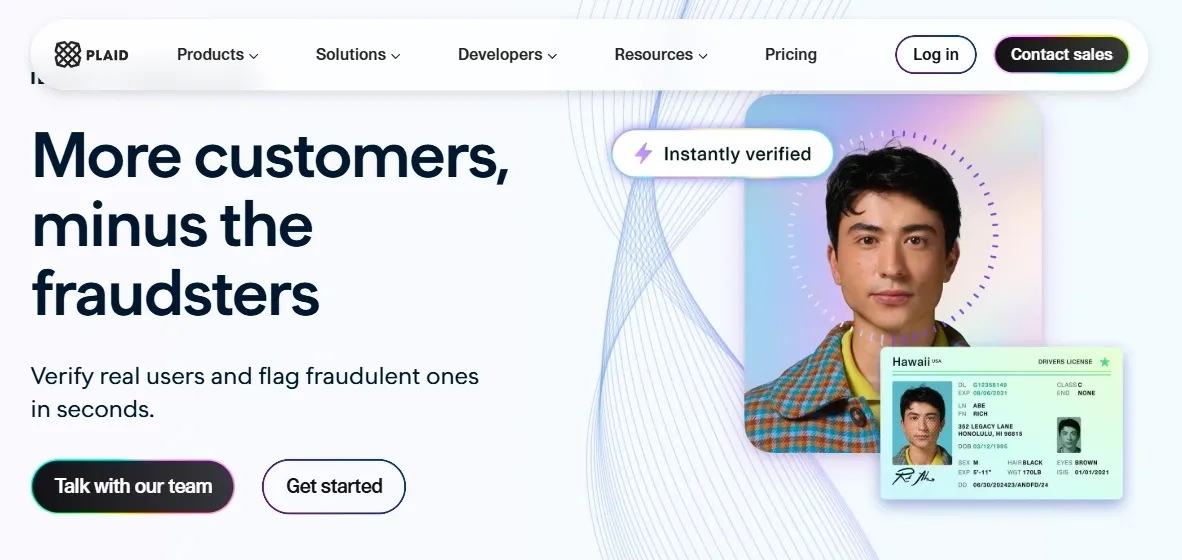
If you use Plaid to connect your users' bank accounts, Plaid Identity Verification makes it much easier for you to integrate a KYC API into your app. It runs inside the same Plaid Link flow your users already know, or you can send them a link to complete the verification.
Plaid Identity Verification features:
- Document and selfie checks
- Data checks without any screens
- Links without a time limit
- Sanctions screening (through Plaid Monitor, a separate product)
Under the hood:
- SDKs: Official server libraries for Node, Python, Ruby, Java, and Go
- Result notifications: With every status change Plaid lets your server know
- Sandbox: Available on the dashboard but selfie checks don't work on sandbox
- Availability: Your company must be based in the US, Canada, or the UK
- Pricing: Plaid doesn't publicly share its prices and has separate pricing for each check type, and a retry is billed as a new session
Plaid Identity Verification is a good KYC API option for US, Canada, and UK apps that are already built on Plaid.
Socure
Best for: US platforms that want fraud signals alongside KYC
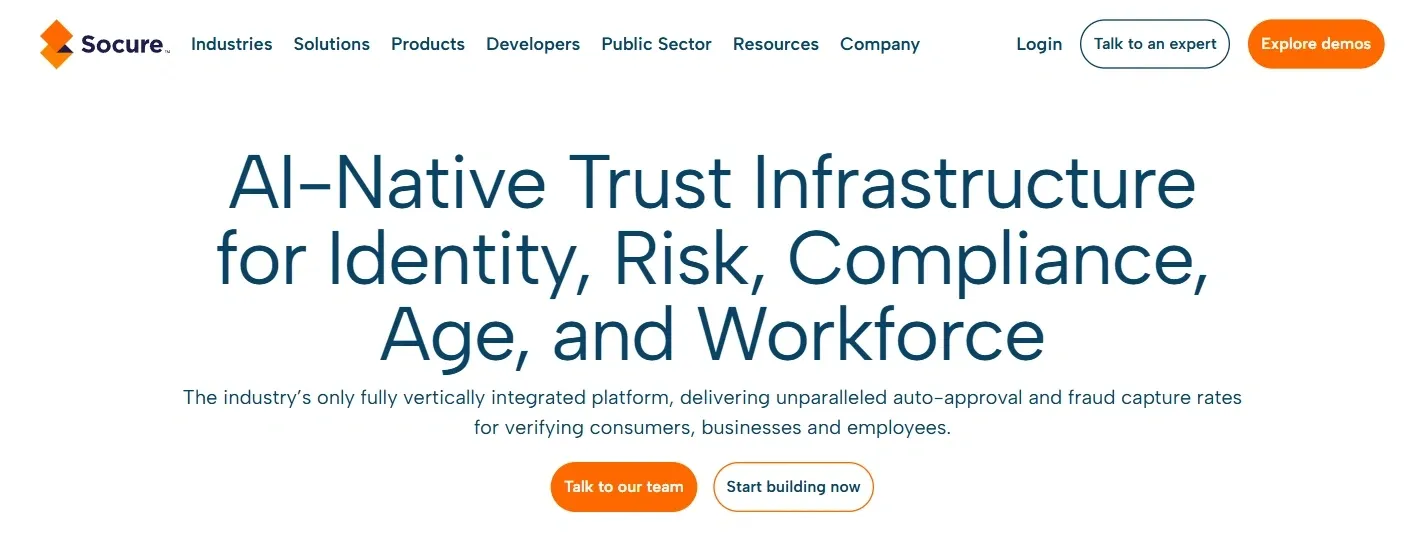
Socure's Launch tier is for developers who want to integrate a KYC API and fraud signals into their app. While Socure has open pricing, cheaper charges, and a free sandbox, Launch is built for verifying people in the US.
Socure features:
- Light checks first, ID and selfie only for risky users
- Fraud scoring
- Watchlist scanning
- Prefilling user details from a name and phone number
Under the hood:
- Integration: Socure has a hosted KYC interface, a web SDK, and iOS, Android, and React Native SDKs
- Sandbox: You can sign up for Socure Launch without talking to sales, but to go to production you need to complete a certification checklist
- Pricing: Socure charges $0.80 for ID and selfie checks, $0.90 with watchlist scanning added, $1.00 for light checks with fraud scoring and watchlist scanning, and $1.30 with prefilling added. Launch also includes $1,000 of free credit a month for checks in production
- Billing: Each verification started in production is billed, even if the user abandons it
- Limits: One active package at a time, 1 check per second, and 500 checks a day
- Business verification: Only on the Enterprise tier, by quote
- G2 rating: 4.5 out of 5 (102 reviews)
Socure is a good option for fields where fraud is an expected risk. Launch is built for US users and Socure warns that KYC for people outside the US might be incomplete.
Jumio
Best for: large businesses that need KYC at scale

Jumio is one of the best known KYC API providers in the market and it supports more than 5,000 ID types across 200 countries and territories. Its KYC flows are fast, but there are some negative reviews that say valid IDs get rejected because of glare or bad lighting and facial recognition might fail.
Jumio features:
- ID and facial recognition
- Reusable identity across Jumio KYCs
- Ongoing monitoring
- AML screening (separate product)
Under the hood:
- Integration: Jumio offers a hosted client, a web SDK, iOS and Android SDKs, and Jumio's GitHub has React Native and Flutter wrappers
- Result notifications: Jumio lets your server know of all results (these results are not signed so you need to verify them by matching with Jumio IPs)
- Access: To get access to Jumio you first contact their sales team
- G2 rating: 4.1 out of 5 (30 reviews)
- Pricing: Quote only
Jumio is a great KYC provider for large businesses that want to integrate a KYC flow at scale. Jumio doesn't list a business verification (KYB) product.
Entrust IDV (formerly Onfido)
Best for: businesses that want KYC along with a large security package
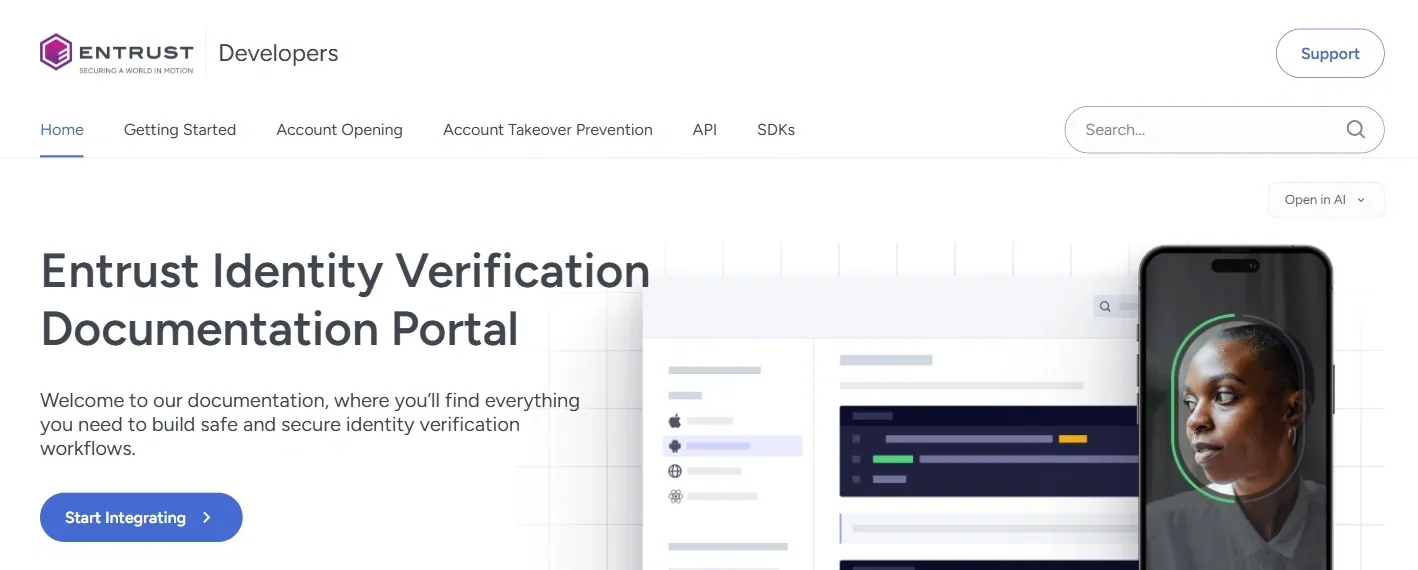
Entrust bought Onfido in April 2024, and the product is now called Entrust Identity Verification.
If your business is already working with Entrust, you can add KYC without bringing in another provider. While many people think the liveness checks and the ID verifications are great, some say support is slow and the workflow isn't as customizable as others'.
Entrust IDV features:
- ID and facial recognition
- Deepfake and mask catching
- Database checks
- Watchlist reports
- Codeless flow builder
Under the hood:
- Integration: Entrust provides a hosted KYC link, a web SDK, and iOS, Android, and React Native SDKs. A new Flutter SDK is due later in 2026
- Result notifications: When verification is complete, Entrust lets your server know
- Sandbox: Although Entrust has a free sandbox, you need to first get in touch with the sales team to create an account
- G2 rating: 4.4 out of 5 (157 reviews)
- Pricing: Quote only
Entrust IDV is a great product for businesses that already work with Entrust, although you should keep in mind that Entrust IDV does not have a KYB product.
Trulioo
Best for: businesses that want to verify other businesses and individuals across many countries

Trulioo provides ID and selfie checks. On top of this, together with its global and local databases, it can search identity information across 195 countries and more than 450 data sources. Unlike some other items on our list, Trulioo also supports KYB.
Trulioo features:
- Business verification
- Finding who owns a business (UBO discovery)
- Data and document checks
- Watchlist scanning
Under the hood:
- Integration: Workflow Studio flows that can be hosted or built with web, iOS, Android, and React Native SDKs
- Result notifications: Trulioo can let your server know of all results in your KYCs and KYBs, although they require a one-time server check beforehand
- Access: Trulioo doesn't have a free trial. You first fill out the contact form and then the Trulioo team provides you with the API credentials
- G2 rating: 4.4 out of 5 (40 reviews)
- Pricing: Quote only
Trulioo is a platform that provides services to businesses that operate in many countries, and you can design the KYC flow without writing any code.
How do you integrate a KYC API?
Integrating a KYC API consists of four main pieces. First, when you start a check, your server makes a call to the provider to create a verification and the provider gives you an ID back. You should save that ID next to the user right away because it is how you'll match the user to the verification result later.

Then the user goes through the verification flow, which works differently depending on which provider you use.
- Most providers offer a hosted link, which means the user will get a link and follow it to the provider's page.
- Others provide an embedded component or a mobile SDK, which means the screens live inside the app while the provider still runs the camera capture and the liveness check.
- Some other providers have an API where you collect the documents and selfie yourself and upload them, which is the highest level of customization you can get.
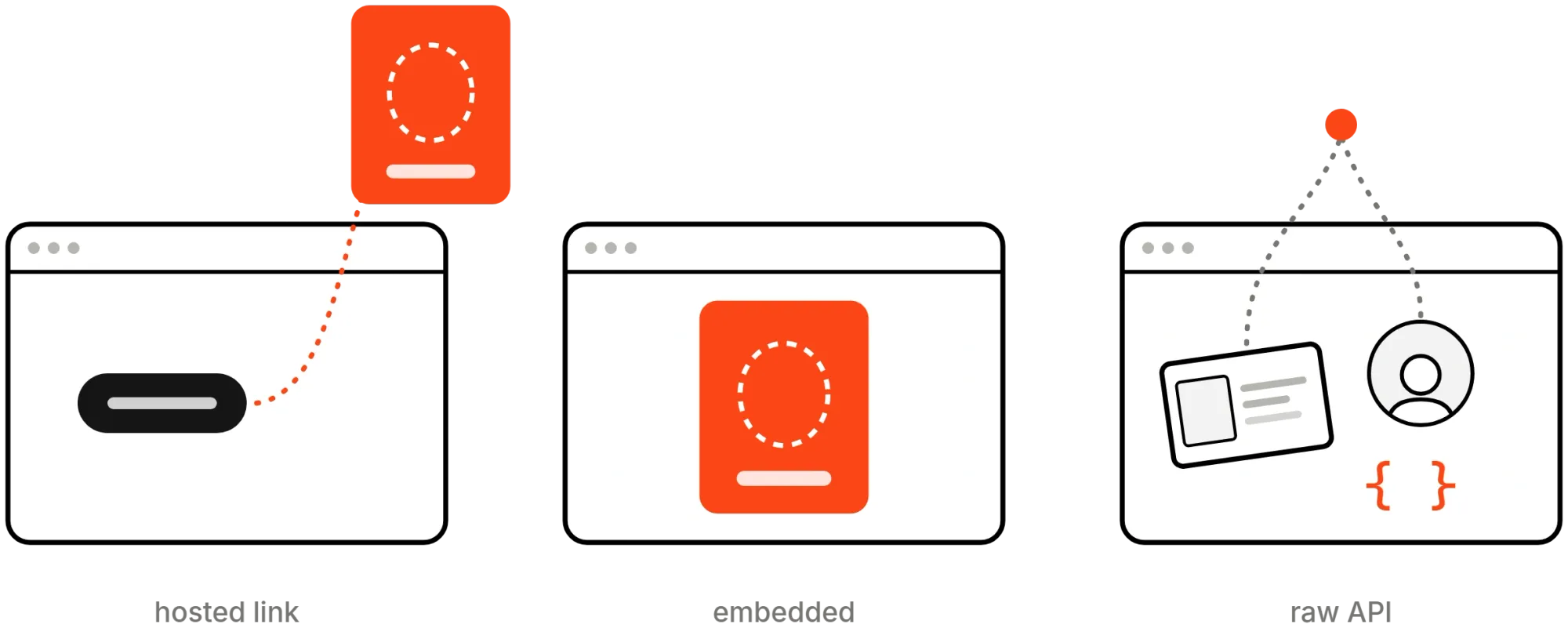
Once verification is done, it's time to get the results. Keep in mind that checks aren't instant and some people abandon their verifications midway. When a result is ready, whether it passed or failed, your provider notifies your server with a webhook.
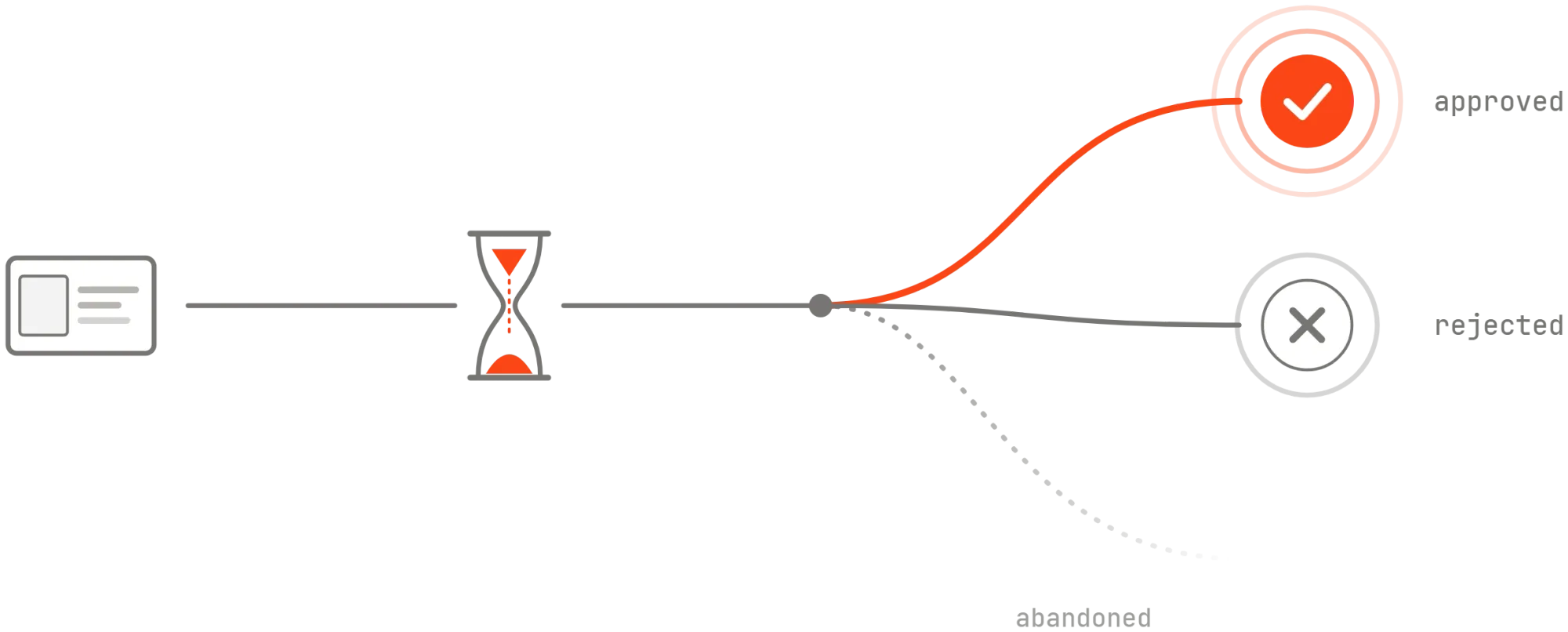
One of the most important parts of integrating a KYC API is the state of the verification where it needs more information. This can be due to blurry photos, addresses that don't match, and more. Providers flag them with their own status and notification saying what's missing.
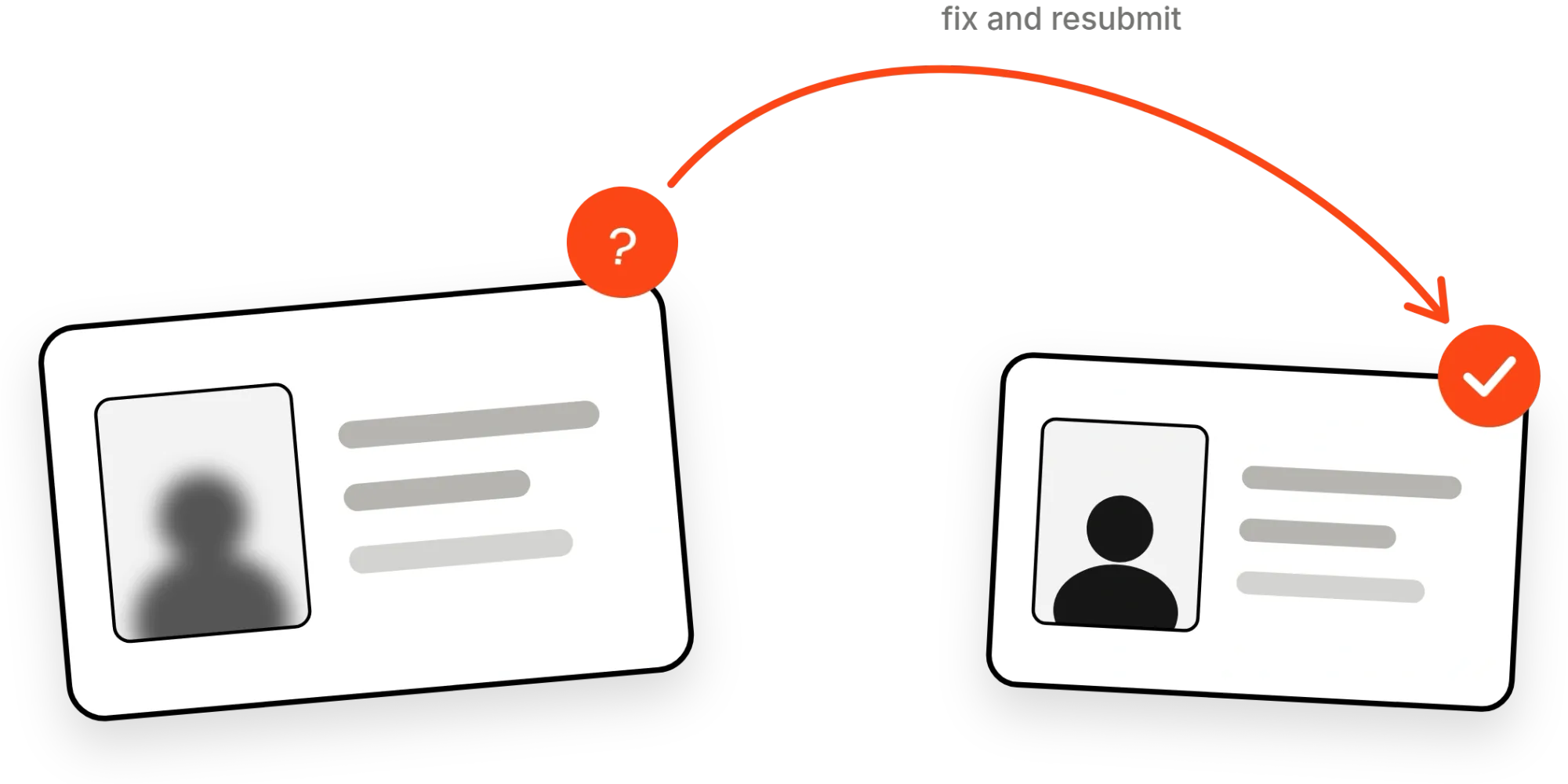
What you should do in this step is to show users what to fix and send them back to the hosted page or submit the details yourself through the API if your provider allows it.
For a full walkthrough with code, see how to integrate a KYC verification API into your platform.
How to choose the right KYC API for you
We have covered 11 KYC APIs in this article, but there are a lot more. Let's talk about how you can actually choose the right one for you.
Think about why you need KYC
If you want to verify your users because you want to pay them out, you should use a solution that comes with both payouts and KYC. Using a separate KYC provider and a payments rail just means more work. Our guides on marketplace payouts and embedded payouts cover how platforms pay their users.
Josh Fabian, founder of the gaming coaching platform Metafy, which runs every payout through Whop, puts the stakes plainly:
"Making sure our partners get paid, properly and on their terms, is the whole promise. Get that wrong and nothing else matters."
- Josh Fabian, Metafy
If you want to implement identity verification for creating an account, verifying age, or anything that doesn't involve money, a standalone identity API like Stripe Identity, Persona, Veriff, or Didit would be a simpler option.
See what works for you
KYC API providers have varying pricing policies including minimums, free credits, plan limits, etc. Here's what it costs to verify each user once at list price:
| Provider | 500 a month | 2,000 a month | 10,000 a month |
|---|---|---|---|
| Whop | Free | Free | Free |
| Socure (US only) | $0 | $600 | $7,000 |
| Didit | $155 | $650 | $3,290 |
| Persona | $250 | $2,500 | $14,500 |
| Veriff | $400 | $1,600 | $8,000 |
| Sumsub | $675 | $2,700 | $13,500 |
| Stripe Identity | $750 | $3,000 | $15,000 |
Decide how much of the verification flow you want to build
Most providers come with hosted KYC pages, which are pages that users go to using a link.
An embedded component or a mobile SDK, on the other hand, keeps your users inside your app and does not require them to leave the app to complete KYC. The third option, a raw API, gives you full control over which information you get and how you get it.
You then send everything to the provider yourself, which means more technical work and more responsibility for bad photos and confused users.
Test your flow before going live
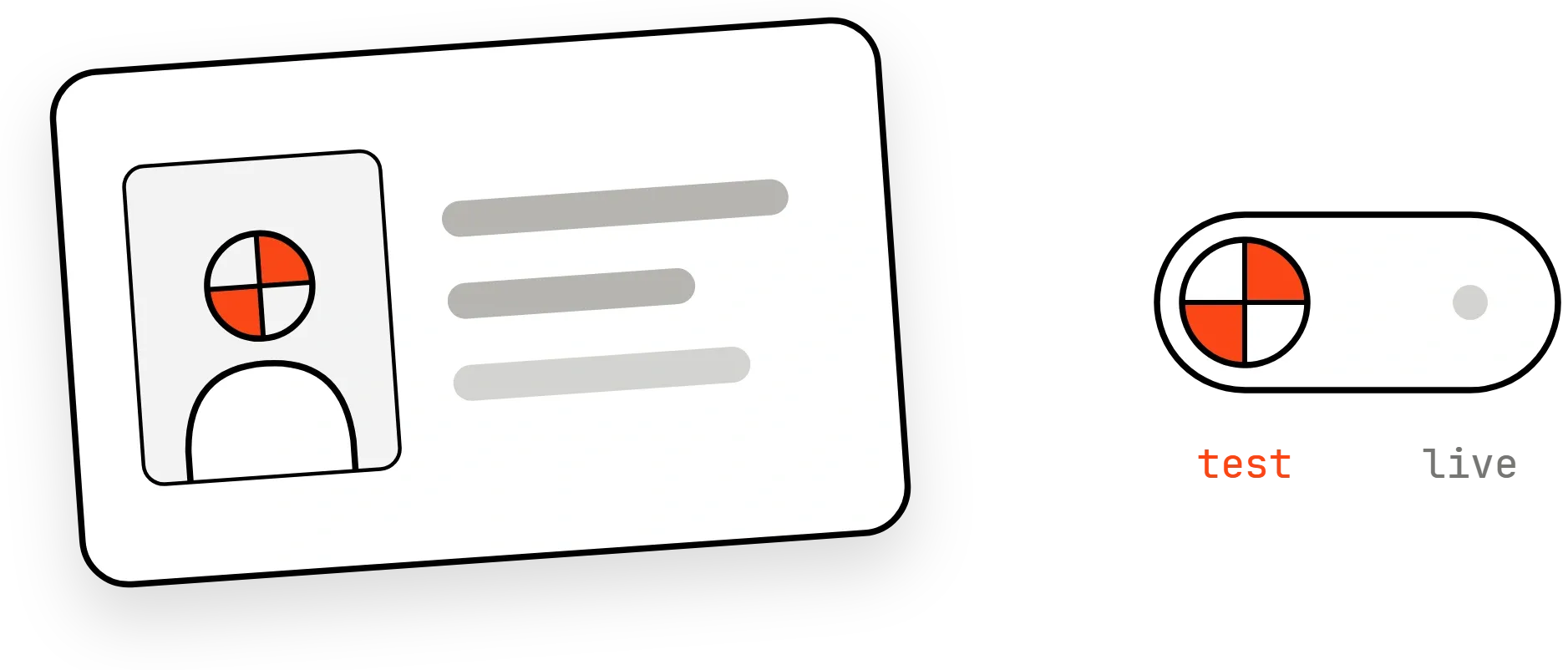
Most KYC API providers, like Whop, Stripe Identity, Persona, and Sumsub, give you a sandbox where you can test the KYC flows without real users or real checks.
Jumio, Entrust, and Trulioo only give you sandbox access after you talk to their sales team, so expect a slower start with them.
Do everything with a single Whop integration
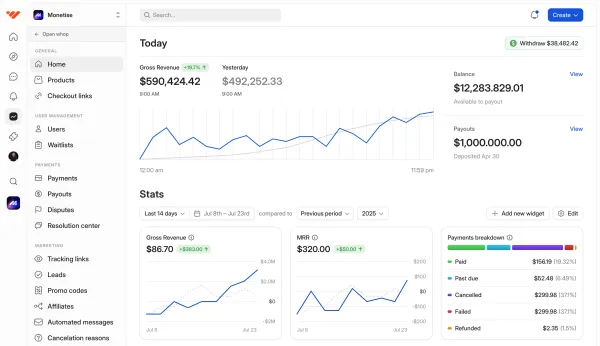
Most providers on this list stop at verification. Whop also takes payments on your users' behalf and pays them out, all through the same integration.
But it's not just the KYC. Whop can help you authenticate your users, payout to people in over 186 countries, and test everything on a sandbox before production. If you want to learn more about what you can do at Whop, check out our other tutorials and our developer documentation.


![Top 10 best embedded finance companies for SaaS and marketplaces [2026]](https://storage.ghost.io/c/12/7b/127b828b-bdc2-4972-9cf2-de857df9c324/content/images/size/w1000/format/webp/2026/08/embedded-finance.jpg)