What each payment orchestration platform covers, how it routes payments, what it costs, and who it's for.
Key takeaways
- Payment orchestration splits into three architectures: all-in-one, bring-your-own-PSP, and white-label platforms.
- All-in-one providers trade PSP neutrality for one contract, simpler reconciliation, and faster market launches.
- Pick a platform by matching architecture to your routing control, geographic coverage, and pricing transparency needs.
The global payment orchestration market was valued at $1.7 billion in 2024, and is now projected to reach $6.1 billion by 2030. That's a 23.7% CAGR (ResearchAndMarkets.com, 2026).
What does this mean for you?
While you're wondering why your auth rates are dropping, reconciling transactions manually, and trying to figure out how to launch in a new geography without months of integration, businesses using payment orchestration are automating that reconciliation, reaching new markets faster, and optimizing costs in real time.
Payment orchestration providers today range from full acquirers that bundle routing into their own stack, to independent layers that sit on top of PSPs you already use, to infrastructure built for platforms reselling payments to their own customers.
This guide covers the top 14 payment orchestration software options, including what each one does, what it costs, and who it's built for.
14 best payment orchestration platforms
Before we get into the list, a quick note on methodology: for this comparison, we read every platform's own product pages, technical docs, and pricing pages. Where a platform didn't publish pricing, we say so rather than relying on third-party reviews.
Platform categorization (All-in-one, Bring-your-own-PSP, White-label platforms) is based on each platform's architecture, not on how the platform chooses to market itself.
Don't have time to read the full entries? Here's an at-a-glance overview of all 14 payment orchestration platforms reviewed.
| Platform | Category | Best for | Coverage | Pricing |
|---|---|---|---|---|
| Whop | All-in-one | Any business wanting global acceptance without building a PSP stack | 195 countries, 100+ payment methods | 2.7% + $0.30; orchestration 0.8%/txn |
| Solidgate | All-in-one | Mid-market subscription & e-commerce consolidating vendors | 100+ provider connections | 2.8% + 25¢ per charge |
| BlueSnap | All-in-one | Education, healthcare, B2B needing gateway + orchestration | 47 countries (acquiring), 200+ geographies (reach) | 2.9% + $0.30 (US); orchestration custom pricing |
| PayU | All-in-one | Enterprises/SMBs targeting CEE, Latam, Africa specifically | 30+ countries, 400+ payment methods | Custom pricing |
| Adyen | All-in-one | Global enterprises wanting one acquirer + AI-driven routing | 200+ payment methods | $0.13 + 2.90% + 30¢; orchestration custom pricing |
| Checkout.com | All-in-one | Enterprise merchants anchoring to one core acquirer | 57+ countries, 150+ currencies | Custom pricing |
| Corefy | Bring-your-own-PSP | Payment institutions, PSPs, fintechs needing deep routing control | 600+ connectors, 1,200+ providers | From €2,500/mo + per-transaction overage |
| IXOPAY | Bring-your-own-PSP | Enterprise merchants & white-label clients, multi-acquirer setups | 200+ PSPs, 300+ payment methods | From €199/mo + €0.10/txn |
| Primer | Bring-your-own-PSP | Product-led teams wanting no-code PSP swapping | 100+ integrations | Custom pricing |
| Spreedly | Bring-your-own-PSP | Platforms/marketplaces wanting engineering-owned routing | 150+ integrations | Custom pricing |
| Gr4vy | Bring-your-own-PSP | Enterprise merchants with engineering resources, max control | 400+ payment methods/anti-fraud providers | Custom pricing |
| ProcessOut | Bring-your-own-PSP | Businesses with existing PSP relationships wanting a routing/monitoring layer | 100+ providers | Custom pricing |
| Norbr | White-label | Platforms/PSPs/PayFacs/ISOs building a branded payment product | 50+ partners, 150+ payment methods | Custom pricing |
| Yuno | White-label | Enterprise merchants with multi-country, high-complexity needs | 1,000+ payment methods, 300+ providers, 200+ countries | Custom pricing |
All-in-one platforms (orchestration plus infrastructure and services)
These are acquirers and payment service providers that have built orchestration into their own stack. Alongside direct acquiring, they offer routing, retries, tokenization, fraud tooling, and reporting under one contract – and increasingly things like billing, payouts, and issuing too.
They're the perfect choice for a specific kind of buyer: businesses currently managing four or five payment vendors who would rather consolidate that onto one platform than add a sixth layer for orchestration on top.
You get fewer integrations to maintain, one reconciliation feed, one support relationship, and a faster route to launching in new markets, because the acquiring is already there.
The trade-off, though, is neutrality. Routing on these platforms mostly happens within the provider's own network and partner acquirers, not across whichever PSPs you choose.
If you want to keep your existing processor contracts and route between them freely, the bring-your-own-PSP layers in the next section will suit you better.
If you'd happily hand the whole stack to one provider in exchange for simplicity, start here.
1. Whop
Whop is the end-to-end platform for building a business. Orchestration is one feature inside that broader platform.
Payment acceptance
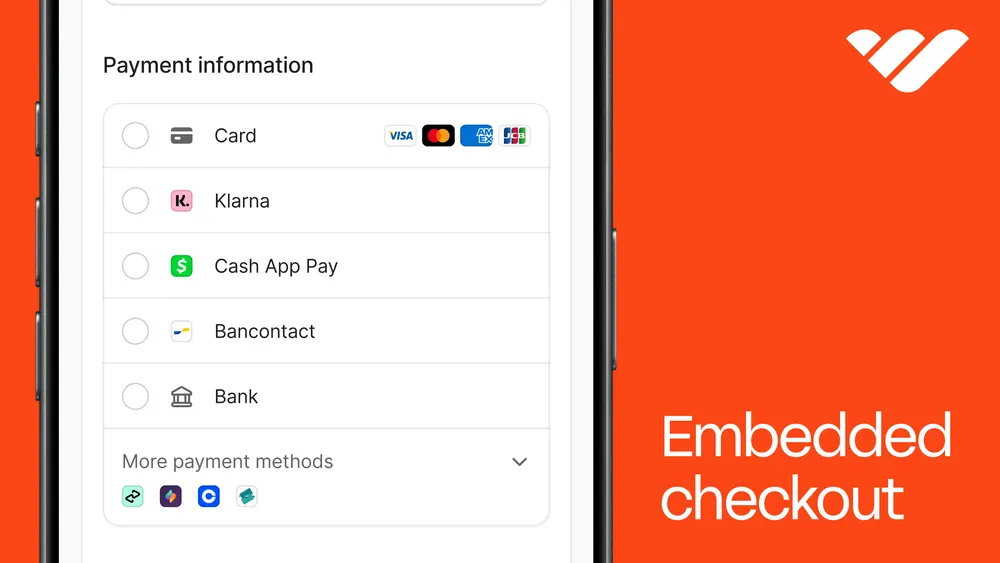
Whop supports payment acceptance across 195 countries, 135+ currencies, and 100+ payment methods. This includes cards, digital wallets, and local payment methods like ACH, iDEAL, and Bancontact.
These local methods appear automatically at checkout, based on the customer's location, currency, and price, with no setup required.
Financing and BNPL are supported by 13 different providers, including Afterpay, Splitit, and even local providers like Kueski and Addi. PayPal and Coinbase Commerce are also supported as additional payment acceptance rails.
Payments can be embedded directly into your product, or accepted through a hosted checkout link.
Payment optimization
For payment orchestration specifically, Whop routes payments through multiple payment service providers and boosts revenue by up to 6%.
Real-time retries and automatic card updates run alongside this, with 3DS, ML-based fraud detection, and early dispute alerts also available as add-on tools.
Reporting and reconciliation
It's a true unified experience: one dashboard covers balances, payouts, and disputes, with automated invoice generation and billing lifecycle handling, plus tax and remittance handling (when tax collection is enabled).
Extra features
On the payments side, payouts run to 200+ countries and territories via bank transfer, mobile wallet, or crypto wallet. This is backed by a broader finance suite covering pay-ins, KYC, and virtual card issuing for platforms and small businesses.
Whop acts as merchant of record for the purpose of card network rules and payment settlement.
Who it's for
Any business type, from local service-based businesses to global platforms like Replit and Cal.com. If you want to accept global payments without building or managing your own orchestration tool or PSP stack, Whop is for you.
Who it's not for
Businesses wanting direct control over PSP selection or routing configuration. Whop's orchestration is a toggleable feature inside a broader platform, not a configurable layer you manage yourself.
How much does it cost?
- Payments: 2.7% + $0.30 per domestic transaction (+1.5% international, +1% if currency conversion applies)
- Orchestration: 0.8% per transaction when enabled, boost revenue by up to 6%
2. Solidgate

Solidgate combines payment orchestration with direct acquiring and other value-add services. Solidgate Orchestration centralizes payment processing across gateways, acquirers, and alternative payment methods.
Connectors serve as the foundation of the payment processing infrastructure by defining available capabilities for payments, and they determine which payment methods, operations, and authentication options you can use for transactions.
Payment acceptance
Solidgate offers over 100 payment provider connections and payment methods. That's a mid-sized network compared to others on this list, but it compensates by being the acquirer itself rather than just a routing layer.
Solidgate has deep coverage across Europe, North America, LATAM, and Asia Pacific. You can use Solidgate to accept payments via payment link or embedded hosted checkout.
And, if you're building on an ecommerce platform (like Shopify or WooCommerce), you can use one of Solidgate's prebuilt payment plugins.
Payment optimization
Through connectors, you get no-code smart routing. The route chosen is decided by geolocation, transaction amount, and real-time conditions. If a transaction fails it is automatically retried through alternative acquirers.
On top of smart routing, Solidgate also offers network tokenization and 3DS to optimize payment acceptance.
Reporting and reconciliation
Solidgate's real-time payments analytics dashboard shows approval volume and rate, and flags fraud and dispute indicators.
Reconciliation runs automatically across every connected provider, consolidating reporting into one dashboard instead of one per PSP.
Extra features
Beyond payment acceptance and orchestration, Solidgate offers subscription billing, recurring payment management, fraud management with customizable rules, chargeback prevention alerts, tax compliance automation, and global business accounts via Treasury (built with banking partner Tuum).
Who it's for
Mid market B2B and B2C subscription and internet goods businesses, fast-growing ecommerce brands, and cross-border marketplaces.
Who it's not for
Businesses wanting PSP neutrality: Solidgate is also the acquirer, which trades some of the vendor independence for consolidation.
How much does it cost?
- Standard rate: 2.8% + 25¢ per successful card charge
- No setup fees; usage-based pricing rather than a flat monthly fee
- Custom pricing available for volume discounts, geo-specific pricing, APMs, and interchange-plus (IC++) pricing, all not publicly shared
- Not self-serve for full onboarding (demo/sales call required)
3. BlueSnap

BlueSnap, now powered by Payroc following Payroc's 2025 acquisition, describes itself as a 'global payment orchestration' platform.
It's a modular platform, where businesses pick which value-added services to turn on by country, product, or issuer, rather than taking on a fixed bundle.
Payment acceptance
BlueSnap supports payments across online checkout, mobile checkout, and embedded payments, alongside subscriptions, invoicing, and even manual orders taken through a virtual terminal.
Local card acquiring is available in 47 countries, with wider payment acceptance reach across 200+ geographies in total.
BlueSnap checkout specifically supports 100+ currencies & 8 payment methods, including ACH, Apple Pay, and credit card, across 4 languages – notably lower than most competitors on this list. The API supports any language and 10 payment methods, including iDEAL and Click to Pay.
Payment optimization
Smart payment routing, network tokenization, and an account updater work together to lift authorization rates, alongside 3D Secure authentication for fraud-sensitive transactions.
Reporting and reconciliation
BlueSnap provides unified analytics and reporting across sales channels, transaction monitoring and reconciliation. Vaulted shoppers keep tokenized payment details on file for repeat and recurring transactions.
Extra features
Subscription and recurring billing, a virtual terminal so customers can pay by phone, email, or fax, global payouts, and chargeback management.
Who it's for
Education, healthcare, and B2B-heavy platforms needing embedded payments plus gateway and orchestration in one contract.
Who it's not for
If you need deep local payment method coverage in emerging markets then BlueSnap's footprint is smaller than other platforms built specifically around LATAM/APAC/Africa depth.
Payroc's own acquisition announcement framed expanding BlueSnap's global reach as one of the deal's goals, with CEO Jim Oberman saying: "This transaction dramatically expands our global footprint and the breadth of capabilities we can bring to our customers and partners" – so expect the coverage map to grow, but evaluate it on what's live today.
How much does it cost?
- Quick start PAYG pricing shows 2.9% + $0.30 per card transaction for US merchants, on Visa and Mastercard (does not apply to high risk merchants)
- Full payment orchestration pricing is custom and requires a sales call
4. PayU

PayU describes itself as a payments partner specifically designed for enterprises, with over 20 years' experience in European online payments.
Through a single API call you get access to local PayU providers and partners, local payment schemes, and the most popular payment methods. PayU's payment orchestration product sits alongside payment processing and PayU enterprise.
Payment acceptance
PayU operates across 30+ countries in LATAM, CEE, and Africa, with 400+ payment methods reachable via a single API across 18 of those markets specifically.
It's a direct acquirer specifically in Poland, Romania, Colombia, Peru, and South Africa.
Payment optimization
PayU's Smart Routing Engine offers 100+ routing configurations by card issuer, geography, transaction size, and other criteria, with A/B testing supported on routing configurations.
Instant Retry automatically re-routes a declined payment to another provider in real time, for technical or financial decline reasons, while MCC/MID redirection routes to the most appropriate merchant ID for the network, evaluating risk in real time based on payer history.
PayU also offers a dedicated approval-rate optimization program for 3DS2/PSD2 readiness.
Reporting and reconciliation
When using PayU, you get access to an advanced Data Analytics & Reporting module and a real-time approval-rate monitoring dashboard, so you get visibility into performance as it happens.
Extra features
PayU is PCI DSS Level 1 certified and ISO/IEC 27001 compliant, with fraud and risk scoring based on device fingerprinting and behavioral signals at checkout. A dedicated Credit division handles BNPL and installment products, run separately from the core payments business.
Who it's for
Enterprises and SMBs in hospitality, ecommerce, and marketplaces specifically targeting CEE, LATAM, or Africa. PayU's differentiator is regional depth and direct acquiring relationships in those specific markets, not global breadth. As Bill Noonan, founder of 4Scale, puts it: "Merchants entering new markets assume cards are king everywhere: they're not. Pairing local payment rails with card acceptance is where you win. The presence of a recognized local method builds the trust that lifts conversion across every payment type at checkout."
Who it's not for
If you want one platform to cover markets outside CEE, LATAM, and Africa, look elsewhere. PayU doesn't compete on global coverage the way Whop, Yuno, Checkout.com, or Adyen do.
How much does it cost?
- No public pricing available for PayU, rates are quoted per merchant
5. Adyen

Adyen is a full acquirer/PSP with its own network, and processes end-to-end through its own infrastructure rather than bolting together acquired systems. Adyen's optimization suite, including payment routing, is branded 'Uplift'.
Adyen for Platforms is a separate embedded-finance stack for businesses wanting payouts and other financial products for their users.
Payment acceptance
Direct in-house acquiring runs in Australia, Brazil, Canada, Europe, Hong Kong, India, Japan, Malaysia, Mexico, New Zealand, Puerto Rico, Singapore, UAE, United States, with partner acquirers used for markets outside of that list.
Adyen covers 200+ payment methods including Visa, Mastercard, Amex, Apple Pay, Google Pay, Cash App Pay, Alipay, WeChat Pay, and a long tail of local methods. Integration options span a hosted drop-in, individual components, an API-only build, plugins, and in-person terminals for unified commerce.
Payment optimization
Adyen Uplift is a five-module suite covering routing, tokenization, authentication, fraud detection, and checkout personalization.
Optimize is the orchestration lever. It uses AI to route, recover, and optimize payments for higher authorization rates and lower costs, with routing weighted toward conversion, cost, or both.
On declines, Auto Retries intelligently retries declined transactions by adapting the route, messaging, authentication, and tokenization, and a separate Auto Rescue feature handles failed recurring payments to reduce involuntary churn.
Excessive Retry Protection blocks payments likely to trigger scheme retry fees.
Reporting and reconciliation
Everything runs through a single Customer Area dashboard, since there's one platform underneath. You get real-time transaction data, settlement and payout reporting, dispute management, and configurable report downloads via API or SFTP.
Within Uplift, Protect adds risk rule backtesting against historical data before going live, plus A/B tests to measure rule effectiveness in real time, and Optimize surfaces recommended optimizations and shows their impact on payment conversion directly.
Extra features
If you're running a platform or marketplace, Adyen for Platforms offers payouts, issuing, and capital. KYC and AML checks are built in.
Who it's for
Global enterprises and large platforms that want one acquirer across most of their footprint and are comfortable letting Adyen's AI handle routing decisions rather than configuring rules themselves. Marketplaces needing payouts and issuing alongside acceptance get the most from the combined stack.
Who it's not for
Like many on the all-in-one list, if you want full PSP-neutral orchestration, Adyen is not for you. Adyen's tools extend its own network, and are not a neutral layer across acquirers.
It's also worth noting that if you're operating outside Adyen's direct-acquiring list above, you'd be running on Adyen's Partner Acquirer tier, not the full in-house stack Adyen offers.
How much does it cost?
- $0.13 fixed fee + payment-method fee per transaction; Visa/Mastercard shown as 2.90% + 30¢ on the US pricing page
- Other methods: Interchange++ + 0.60%
- No setup or monthly fee
- Platforms/Issuing/Capital priced separately
- Uplift (which covers payment orchestration) is not shared publicly – pricing requires sales call
6. Checkout.com

Checkout.com is a global acquirer and payment platform built around its own direct acquiring infrastructure, with the dashboard itself framed around 'orchestrating' payments and finances across its full stack.
Payment acceptance
Processing in 57+ countries, 150+ processing currencies, and around 20 settlement currencies. It accepts all major cards (Visa, Mastercard, Amex, Discover, JCB, Diners) plus bank debits (ACH in the US, SEPA in the EU) and a wide range of digital wallets and local payment methods.
Integration options include Accept Online, Unified Payments API, Flow, Hosted Payment Page, Mobile SDK, Payment Links, and plugins, so there's plenty to choose from.
Payment optimization
Intelligent Acceptance is Checkout.com's optimization engine: a self-learning system that balances acceptance, cost, and fraud in real time, rather than a single setting.
It works across five points in the payment flow at once: authentication, message formatting, network tokens, routing (the payment orchestration lever, sending each payment down the network most likely to succeed), and retries. This is enabled by request through an account manager, not self-serve.
Reporting and reconciliation
The dashboard is a single control point across the full stack: Acquiring, Fraud Detection, Intelligent Acceptance, Issuing, and Disputes.
Custom analytics run through the Data Explorer or configurable Boards, and granular breakdowns by card type, payment method, currency, are backed by API/SFTP/webhook-based reporting
Extra features
Fraud detection, identity verification, disputes management, vault (tokenized card storage) are all available, alongside card issuing and platform payments.
Who it's for
Enterprise merchants anchoring their stack to Checkout.com as their core acquirer. Its own case studies and customer references (Klarna, Vinted, Reach, Ant Group) point toward large-scale businesses rather than smaller merchants.
Who it's not for
Again, businesses wanting true multi-PSP neutrality, as it is limited outside its own ecosystem.
How much does it cost?
- No public per-transaction rate table – pricing requires direct contact with Checkout.com for a quote
Bring-your-own-PSP platforms
These platforms don't process payments themselves. They sit between your business and the PSPs and acquirers you already contract with, routing each transaction to whichever one is most likely to approve it at the lowest cost, and cascading to the next if it fails.
So when it comes to 'payment acceptance' for this group, it isn't what the platform can process directly, but how many PSPs and payment methods you can plug into through it. A layer with 600 connectors gives you a different negotiating position than one with 60.
You keep full control over your own PSP relationships and how you route between them, so you can add, drop, or A/B test processors without re-integrating. And, card credentials are tokenized by the orchestration layer rather than by any one PSP, so switching processors doesn't mean re-collecting card details from your customers, and no single provider can hold your recurring revenue hostage.
The downside? You're still managing multiple contracts, settlements, and support relationships, and paying each PSP's processing fees on top of the orchestration fee.
Sure, you're doing it from one control panel instead of five, but you're still the one doing it.
7. Corefy

Corefy is a payment orchestration platform that integrates payment providers and acquirers around the world into one communication, control, and management interface. It serves a mix of industries, including gambling, crypto, marketplaces, and dating and adult niches.
And, it's the only platform in this section that has a transparent pricing model.
Payment acceptance
There are over 600 pre-built connectors to global PSPs, acquirers, and alternative payment providers, with more than 1200 payment providers in the Corefy network.
Corefy also offers a checkout builder, payment links, payouts, and batch payouts as separate products.
Payment optimization
Corefy's smart routing engine uses 100+ attributes to decide where each transaction goes. It also auto-retries failed transactions through another eligible provider without the customer re-entering details.
If you want control, a no-code visual rule editor lets you configure routing logic, with drafts, approvals, and role-based access, and you can auto-adjust rules based on live conditions (e.g. relaxing 3DS after a run of successful transactions).
Reporting and reconciliation
Analytics, reconciliation, tokenization, and anti-fraud controls run through one unified system rather than per provider. This matters once you're routing across 600+ connectors and would otherwise have to reconcile each one separately.
Extra features
If you want to process payments under your own brand, Corefy offers a white-label gateway. Then there's 'Payment bridge' by Corefy, which is an extension layer that provides instant access to 600+ payment connectors without migration or disruption (if you already process payments through a proprietary payment gateway or a third-party orchestration system).
Who it's for
With this level of features, Corefy is best suited to payment institutions, PSPs, fintechs, and large merchants managing complex, multi-provider setups who need deep routing control.
Who it's not for
At the same time, it's not ideal for smaller merchants running one or two PSPs who don't need this level of routing granularity.
How much does it cost?
- Plans start at €2,500 infrastructure fee per month for the Standard plan, including 10,000 successful transactions, with €0.072 for each transaction exceeding the plan
- Increases to €6,000 infrastructure fee for 100,000 successful transactions, €0.024 for exceeding transactions
- Enterprise-level fees for >1,000,000 monthly transactions is tailored to the business
- Custom hosted payment page €1,500 one time
- New payment flow integration €1,500 one time
- White-label pack €1,500 per month
- These fees are for Corefy's infrastructure only – you still need direct contracts with your own PSPs, and pay their processing fees separately on top
8. IXOPAY

IXOPAY describes itself as 'the performance layer driving agentic payments', with enterprise-grade payment orchestration, tokenization, and payments intelligence.
Payment acceptance
Plugin-based integration of acquirers and PSPs connects merchants to 200+ PSPs and 300+ payment methods. IXOPAY is a purely technical platform and does not provide a merchant account itself. Payment adapters form the technical connection between IXOPAY and the payment ecosystem via API, so you need your own contracts with acquirers and PSPs.
If you're a platform, there's also a White Label Solution so you can resell orchestration under your own brand.
Payment optimization
IXOPAY offers intelligent transaction routing with configurable rule sets, plus cascading to alternative providers on failure. There's also card vaulting (PCI-compliant tokenization), a card updater to keep stored payment details current, and risk profiles for fraud checks (priced per check).
A newer Payments Intelligence suite adds AI-driven analytics and anomaly detection, including IXONav, an AI assistant built to surface routing and cost-optimization opportunities.
Reporting and reconciliation
A post-processing engine handles provider settlements and reconciliation, alongside a customizable dashboard for monitoring transaction flows.
Extra features
Virtual terminal, customer payment profiles, payment scheduler, Pay by Link, and data import/export, all bundled into the higher-tier plan.
Who it's for
Enterprise merchants, PSPs, and white-label clients running multi-acquirer setups who want routing flexibility without being locked into one provider.
Who it's not for
Merchants wanting a single all-in-one provider. IXOPAY isn't a full-stack PSP, so you still need your own contracts and technical onboarding with acquirers, PSPs, and fraud/3DS services. This adds significantly more vendor management overhead compared to an all-in-one platform.
How much does it cost?
- Starter: €199 per month (includes a 7-day free trial) with a per-transaction fee of €0.10
- Growth: €499 per month, with a per-transaction fee of €0.08
- Both tiers charge separately for card vaulting (€0.02 per month per stored token), card updater (€0.20 per update), and risk checks (€0.015 per check)
- Enterprise tier exists above Growth but isn't priced publicly, requires contacting sales
9. Primer

Primer calls itself 'Unified Payments Infrastructure', which is its own name for the routing and connectivity layer. It doesn't acquire or process payments itself. Instead, it sits between your business and the PSPs you connect through it, giving you one API and dashboard instead of many.
Payment acceptance
100+ pre-built payment provider integrations, added through a Connections marketplace managed through your dashboard. Primer Checkout provides a localized, high-conversion checkout for web and native apps.
Payment optimization
When a payment fails, Primer's Fallbacks feature automatically retries it through a backup processor that you've chosen in advance.
Alongside this, Primer offers network tokenization, and 3D Secure (which only presents when authentication is needed). AI Companion sits alongside these as an assistant for managing payments operations.
Reporting and reconciliation
Real-time visibility across the payment stack, and settlement data is consolidated into one source of truth. A newer product named 'Costs Overview' surfaces fee leakage and lets you benchmark against providers to protect your margin.
Extra features
If you need cross-border money movement, Global Accounts let you access local accounts in 20+ countries, with transparent FX rates and payouts to 200+ countries and territories.
On top of that, Apps and Integrations lets you plug in fraud, billing, and other third-party tools the same way you'd add a PSP.
Who it's for
Product-led teams, with lean engineering resources rather than a dedicated payments engineering org, who want to test and swap PSPs and payment methods per market without having to write code.
Who it's not for
Anyone who wants deep custom engineering control over routing logic rather than a no-code builder. Plus, if you're a smaller business without the need for multi-market routing, it may be overkill.
How much does it cost?
- No public pricing, every path to a quote runs through booking a demo
10. Spreedly

Spreedly calls itself 'An open payments platform that gives you the freedom to connect any provider and intelligently orchestrate every payment flow'. It has been running since 2007, making it one of the longest-standing independent orchestration layers, and its architecture reflects an older, more engineering-first era of payments than newer no-code entrants like Primer.
It's built around five pillars: Vault, Connect, Protect, Optimize, and Resolve. Connect is the orchestration layer.
Payment acceptance
Spreedly connects to 150+ pre-built gateway and payment service integrations and 60+ payment methods through one API, covering local and cross-border payment methods. Because the vault sits above any single gateway, you can add or switch providers without re-collecting customer card data each time.
Payment optimization
Payment routing is dynamic: Spreedly uses performance data across gateways to send each transaction to whichever is statistically most likely to succeed, rather than following a fixed path.
This runs on top of the vault, which handles tokenized card data.
Reporting and reconciliation
A single dashboard shows performance across every connected gateway, so you can measure success rates, transaction health, and which providers are underperforming, all in one place.
Extra features
Protect is Spreedly's fraud and authentication layer, running fraud checks before a payment is sent to the gateway. Resolve is the operational layer underneath all of this, with centralized management, billing control, and reporting.
Who it's for
Platforms, marketplaces, and enterprise merchants running multiple processors – particularly if you want engineering ownership over routing logic rather than a no-code interface like Primer.
Who it's not for
If you want a single end-to-end payments provider, Spreedly is not for you. It doesn't handle acquiring, payouts, invoicing generation, payment links, or a virtual terminal, so you're still assembling these pieces elsewhere.
How much does it cost?
- No public pricing for performance optimization (which includes routing), requires a sales call
11. Gr4vy

Gr4vy describes itself as a cloud-native payment orchestration platform built for enterprise merchants who want full control over their payment stack without being locked into one provider.
Payment acceptance
With Gr4vy you get 400+ payment methods and anti-fraud providers through one integration. Gr4vy is PCI DSS Level 1 compliant, with dedicated cloud instances per merchant (not shared infrastructure). It works across all major cloud providers (like Google, Microsoft, and AWS).
Payment optimization
When it comes to orchestration, Gr4vy routes by card type, BIN range, transaction amount, or custom metadata. Retry rules and timeout controls are configurable per provider.
Gr4vy Workflows is a no-code rules engine that is also used for checkout personalization, showing different payment options per customer based on real-time purchase/shopping data (including BNPL options).
With Gr4vy you get custom risk rules, control over when 3DS triggers, and the ability to decline transactions early.
Reporting and reconciliation
A centralized dashboard gives insights into transaction health and processor performance in one place. You also get real-time monitoring and alerts and settlement reports that track payout dates, amounts, currencies, fees, and transaction status across every provider and merchant account – scheduled or automated, not just on-demand.
Extra features
Gr4vy's Cloud Vault stores and tokenizes card data, network tokens, PSP tokens, raw card/billing details. This works standalone or can be fully integrated with the orchestration platform.
Note: the vault data belongs to the merchant, not the PSP, and supports switching providers without re-collecting card data.
Who it's for
Enterprise merchants and platforms with real engineering resources wanting maximum control over payment architecture.
Who it's not for
Smaller merchants or teams without technical resources to configure custom routing logic and metadata-based rules.
How much does it cost?
- There's no public pricing for the core orchestration platform – quote-based, contact sales
12. ProcessOut
ProcessOut is payment infrastructure with multiple offerings, including orchestration, AI smart routing, monitoring, vault, and a compliance suite.
Acquired by Checkout.com in 2020, it states it operates as a standalone, contractually agnostic business unit that doesn't share tech resources with its parent, routing millions of transactions a week to dozens of providers based purely on performance. This is quite unusual, as most acquired companies get folded into the parent's branding, but ProcessOut has stayed contractually independent.
Payment acceptance
Through one API, ProcessOut connects to 100+ payment providers, letting merchants accept card payments (including Apple Pay, Google Pay, and network tokens) and alternative payment methods, with integration options spanning client SDKs, server-to-server, and hosted payment pages.
Payment optimization
Orchestration personalizes the payment methods you show your customers with Dynamic Checkout, and ProcessOut says you can 'enable any new payment provider across the world with a click'.
As well as this, ProcessOut offers AI-driven smart routing, which uses statistical models and machine learning to automatically choose the best provider for each transaction.
Tokens are saved to capture future payments without re-collecting card details, and CVC/AVS checks run as part of authorization.
Reporting and reconciliation
A Data Explorer gives analytics on payment performance, alongside Anomaly Detection for spotting issues automatically rather than manually.
Extra features
Data warehouse exports let you pull payment data directly into your own systems, rather than relying solely on ProcessOut's own dashboard for analysis.
Who it's for
ProcessOut is well suited to businesses that already have one or more provider relationship and want a routing and monitoring layer on top.
Who it's not for
If you want a single acquiring relationship in one place, this isn't it. ProcessOut sits on top of the providers you already contract with rather than being an acquirer itself, so you're still managing those relationships directly.
How much does it cost?
- Pricing not publicly shared, requires a demo/sales call
13. Yuno
Yuno, described as 'the AI-native operating system of global payments and financial services', is supported by names like GoFundMe, Copa Airlines, and Carrefour.
Payment acceptance
Yuno has the widest payment-method coverage of any platform on this list, with over 1,000 payment methods and 300 payment providers across 200 countries and territories – all through one API. It is positioned explicitly against the idea that any single provider can cover everything a business needs, since no one PSP manages every payment method a global business requires.
Payment optimization
Yuno uses smart routing, a modular checkout builder (which supports drag-and-drop configuration and A/B testing by region), and real-time monitoring that automatically detects anomalies and reroutes transactions when something's going wrong.
There's also an AI layer on top of orchestration – NOVA. Launched in September of 2025, NOVA is a suite of AI agents that recover failed payments through real-time customer outreach by phone and WhatsApp, localized across 70+ languages.
Reporting and reconciliation
Reconciliation and reporting run through a unified dashboard giving you full visibility into payment data. Refunds and cancellations can be managed centrally through that same dashboard regardless of which underlying processor handled the original transaction.
Extra features
Yuno also powers pay-ins and payouts through the same platform and API, so you don't need a separate integration for money leaving your business.
Who it's for
Enterprise merchants with the kind of complexity Yuno's own materials call out directly: launching in new countries quickly, running many payment methods and PSPs without separate integrations for each, and needing AI-driven recovery on failed payments rather than just retry logic.
How much does it cost?
- Pricing not publicly shared, requires a demo/sales call
White-label platforms
Our final set of orchestration platforms are white-label. They aren't built for merchants looking for the best individual PSP, they're built for breadth: as many connections as possible, at as large a scale as possible. As a result, they're often designed to be white-labeled rather than used under the provider's own name.
That changes what 'payment acceptance' means for this group too. It's not what the platform processes directly, and it's not quite the same as the bring-your-own-PSP layers either (there, it's how many PSPs you can plug into). Here, it's how many providers and payment methods you can offer, white-labeled, to the merchants who use the platform you're building.
The following platforms aren't for merchants looking for the best PSP to run their own checkout, but for companies building a payment product that other businesses use, such as a software platform that wants to offer payments as a built-in feature for its own customers.
If that's not you, the all-in-one or bring-your-own-PSP categories above are a better fit.
14. Norbr

Norbr describes itself as 'the global payment infrastructure', saying it provides white-label payment infrastructure for ISVs, PayFacs, ISOs, and large merchants, enabling custom integrations, built to order.
Payment acceptance
Norbr lets you activate the providers and payment methods you need, white labeled under your brand. Norbr states 50+ partners and 150+ payment methods are supported out of the box.
Payment optimization
Payment orchestration covers routing, retries, and recovery for every transaction. Merchants set the logic, with each merchant on your platform getting their own Routing Matrix with no-code rules based on country, payment method, amount, MCC, BIN, or channel. Each merchant builds what they need, directly in the Console, without involving your team.
Reporting and reconciliation
Payment performance is monitored in real time. Every settlement and fee is reconciled, and you can export and deliver payment data anywhere rather than being limited to Norbr's own dashboard.
Extra features
Norbr's Smart Checkout lets each merchant configure their own checkout experience, and Cross-PSP Tokenization provides acquirer-agnostic tokens to reduce churn if a merchant switches providers. Platform Supervision traces every event, delivery, and action across the platform for oversight.
Who it's for
This is for platforms, PSPs, PayFacs and ISOs building their own branded payment product.
Who it's not for
If you just want to accept payments for yourself, Norbr is not for you.
How much does it cost?
- Pricing not publicly shared, requires a demo/ sales call
Honorable mentions
A couple of platforms came up in our research but didn't make the main 14, because neither is quite a payment orchestration platform in the same sense as the rest of this list.
SDK.finance: this isn't actually a payment orchestration platform but a core banking/ledger platform for building a full financial product, where payment acceptance runs on Corefy's orchestration layer under the hood. If that's what you need, see Corefy above instead.
Stripe has an orchestration product too, letting users route across multiple processors and retry failures automatically. It's currently in private preview, so most businesses can't access it yet. It's worth watching, but not yet evaluable alongside the 14 above.
Choosing the right payment orchestration platform for your use case
You've just read through 14 different payment orchestration platforms – so how do you choose between them?
Start with the problem you're trying to solve. 'We need payment orchestration' is fine, but it's too vague to make decisions against. The real question to ask is why you need payment orchestration.
Here are a few examples of what the problem usually is:
- Your PSP doesn't support local payment methods in a market you're entering (you need coverage there specifically). A coverage gap like this often means either an all-in-one platform with local methods built in. Whop supports local payment methods automatically across 195 countries, or PayU specifically for CEE/LATAm/Africa depth, or a bring-your-own-PSP layer with deep connector breadth (Corefy, IXOPAY) that can plug in a local provider without ripping out what you already have.
- Your auth rates are dropping and you don't know why (you need routing visibility). This is where AI-driven routing and monitoring are worth it. Adyen's Uplift, Checkout.com's Intelligent Acceptance, or ProcessOut's Anomaly Detection are all built specifically to surface why a rate is dropping, not just report that it is.
- You're still manually reconciling across multiple dashboards (this is a reporting problem, not an acceptance one). Primer's Costs Overview product exists specifically for this, surfacing fee leakage and benchmarking providers rather than requiring you to piece it together yourself across separate PSP dashboards.
- Launching in a new country would take months (you have a speed-to-market problem). All-in-one platforms with acquiring already in place solve this fastest, since there's no new acquiring relationship to stand up. Whop, Adyen, and Checkout.com all fit here, as does Solidgate for European/LATAM/APAC expansion specifically.
Figure this out first and the list narrows, as each of these points toward a different category. Coverage gaps often mean that you need a bring-your-own-PSP layer. Reporting problems can sometimes be solved without switching platforms at all, and speed-to-market usually means using an all-in-one platform that already has acquiring built in.
Once you have your shortened list, loop in the right people before you start comparing vendors on a serious level. Payments and finance teams can help you evaluate requirements, while engineering will evaluate integration effort, and whoever owns compliance or risk will assess fraud tooling capabilities.
Now, weigh each platform on your shortlist against these 7 criteria, against the issue that you are trying to solve with a payment orchestration provider:
- Payment method and geographic coverage: does it support your specific target markets and methods? Not just now, but a year down the line?
- Routing control and optimization: can you configure and test routing yourself, or will each change require a ticket?
- Data visibility and reconciliation: will you get one dashboard, or will you still need to match records manually?
- Self-service capabilities: can you activate a PSP yourself? Is there a sandbox?
- Ease of integration and flexibility: what integration methods already exist, and how much eng time does setup take?
- Operational toolkit: are subscriptions, fraud, and financial ops built in, or will you need extra vendors?
- Vendor support and expertise: who's there when something goes wrong? How much help will you get with migration?
Before you commit, run demos against real scenarios, test the API in a sandbox, and talk to other customers who are running a business similar to yours.
Payment orchestration, built in with Whop

Payment orchestration platforms all solve a version of the same problem – routing, reconciling, and optimizing payments across multiple providers. The best fit for you depends on how much of the stack you want to own yourself vs how much you want to hand off.
If you're a business that wants to accept payments globally without building or managing a PSP stack, Whop handles that for you, with payment acceptance, orchestration, payouts, and the rest of the finance stack in one place.
FAQs
What's the difference between payment orchestration and a payment gateway?
A payment gateway is a single entry point that connects your checkout to one processor. Orchestration sits a layer above that, managing routing across multiple gateways, processors, and payment methods at once, deciding which one a transaction should go through and what happens if it fails. To put it simply – a gateway gets you connected; orchestration decides where the connection goes.
Do you need orchestration with only 1-2 providers?
If you only have 1-2 providers then you probably don't need orchestration just yet. Orchestration becomes worth it when you're managing enough providers, markets, or payment methods that turn manual routing, reconciliation, and failover into a big burden.
How long does it take to implement a payment orchestration platform?
It varies by platform and how much you're changing at once. Some platforms can go live in as little as a day for simple setups, others take weeks.
How much does payment orchestration cost?
It varies. Some platforms charge a flat rate per transaction (like Whop, Solidgate, and Adyen), some charge a monthly infrastructure fee plus per-transaction coverage, and most don't publish pricing at all. Whop charges 2.7% + $0.30 per domestic transaction, plus 0.8% per transaction for orchestration specifically when enabled.
Does Stripe offer payment orchestration?
Stripe has a product called Orchestration that lets you route payments across multiple processors and automatically retry failures on an alternative route. It's currently in private preview.